羟 (qiǎng) means "hydroxyl (chemical radical)" in Chinese. It has 11 strokes with the radical 羊.
Rated 4.2/5 in difficulty (advanced).
Appears in 3+ common words including 羟基 (qiǎng jī), 羟化 (qiǎng huà), 羟基酸 (qiǎng jī suān).
Due to its 11 strokes, Hanzi Writer's error detection shows 羟 requires focused practice — most learners need 10+ attempts for consistent accuracy.
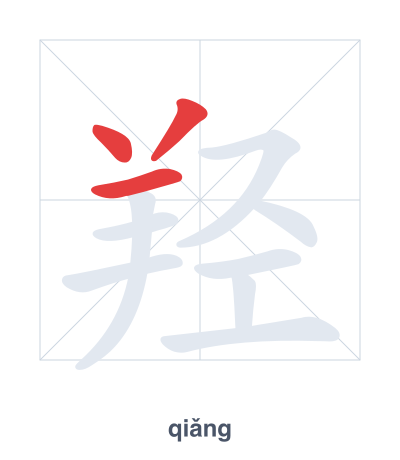
Open Hanzi Writer to see the animated stroke order and practice writing 羟 with real-time feedback.
The character 羟 (qiǎng) is written with 11 strokes. Follow the standard Chinese stroke order: top to bottom, left to right, outside before inside. The radical 羊 is one of its key components.
Practice the correct stroke order with the Hanzi Writer app to see animated stroke-by-stroke guidance with real-time feedback.
羟 means hydroxyl (chemical radical).
| Character | 羟 |
| Pinyin | qiǎng (qiang) |
| Meaning | hydroxyl (chemical radical) |
| Strokes | 11 |
| Radical | 羊 |
| Difficulty | 4.2/5 |
羟 is a modern compound character created for chemistry. It combines 羊 (sheep) from 氧 (oxygen) and 巠 (jīng) from 氢 (hydrogen), symbolizing the hydroxyl group as a union of oxygen and hydrogen.
💡 Memory Tip: Imagine a sheep (羊) standing on a watery stream (巠) representing the hydroxyl (OH) group where oxygen is the sheep and hydrogen is the flowing water.
羟基是化学名词。
qiǎng jī shì huà xué míng cí
Hydroxyl is a chemical term.
这种物质被羟化了。
zhè zhǒng wù zhì bèi qiǎng huà le
This substance has been hydroxylated.
羟基酸对皮肤好。
qiǎng jī suān duì pí fū hǎo
Hydroxy acids are good for the skin.
Open Hanzi Writer to see the animated stroke order and practice writing 羟 with real-time feedback.
✨ Animated stroke order · Handwriting recognition · HSK-graded practice · Free to use
羟 is composed of two parts: the left side is 羊 (yáng, sheep) and the right side is 巠 (jīng, a phonetic component). The 羊 radical here is a simplified form related to the concept of 'sheep' but in chemistry it is used as a phonetic hint, while the overall character represents 'hydroxyl' (a chemical group). The meaning comes from the combination in technical chemistry terminology.