羝 (dī) means "ram" in Chinese. It has 11 strokes with the radical 羊.
Rated 4.2/5 in difficulty (advanced).
Appears in 3+ common words including 羝羊 (dī yáng), 羝乳 (dī rǔ), 羝触 (dī chù).
Due to its 11 strokes, Hanzi Writer's error detection shows 羝 requires focused practice — most learners need 10+ attempts for consistent accuracy.
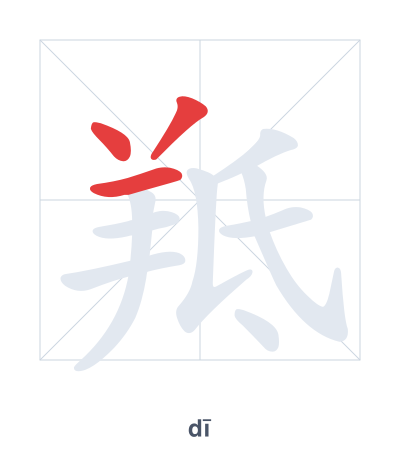
Open Hanzi Writer to see the animated stroke order and practice writing 羝 with real-time feedback.
The character 羝 (dī) is written with 11 strokes. Follow the standard Chinese stroke order: top to bottom, left to right, outside before inside. The radical 羊 is one of its key components.
Practice the correct stroke order with the Hanzi Writer app to see animated stroke-by-stroke guidance with real-time feedback.
羝 means ram.
| Character | 羝 |
| Pinyin | dī (di) |
| Meaning | ram |
| Strokes | 11 |
| Radical | 羊 |
| Difficulty | 4.2/5 |
羝 is a compound character: the radical 羊 (sheep) indicates the meaning of a male sheep, while the phonetic component 氐 (dī) provides the pronunciation, together forming the word for 'ram' (a male sheep).
💡 Memory Tip: Picture a ram (羊) with a low, grounded stance (氐) as it prepares to charge.
羝羊就是公羊。
dī yáng jiù shì gōng yáng
A 'di yang' is a ram.
羝羊不能产乳。
dī yáng bù néng chǎn rǔ
Rams cannot produce milk.
羝羊触藩。
dī yáng chù fān
A ram butting a fence (stuck in a dilemma).
Open Hanzi Writer to see the animated stroke order and practice writing 羝 with real-time feedback.
✨ Animated stroke order · Handwriting recognition · HSK-graded practice · Free to use
The character 羝 combines the radical 羊 (sheep) on the left and 氐 (dǐ) on the right. The 羊 component directly indicates that the character refers to a type of sheep — specifically a ram. The right side 氐 originally meant "bottom" or "to arrive," but here it mainly provides pronunciation (dī) rather than meaning.