阎 (yán) means "gate of a village; the surname Yan" in Chinese. It has 11 strokes with the radical 门, and is HSK Level 7.
Rated 4.2/5 in difficulty (advanced).
Harder than 96% of HSK Level 7 characters.
Appears in 3+ common words including 阎老师 (yán lǎo shī), 阎王 (yán wáng), 阎罗 (yán luó).
Due to its 11 strokes, Hanzi Writer's error detection shows 阎 requires focused practice — most learners need 10+ attempts for consistent accuracy.
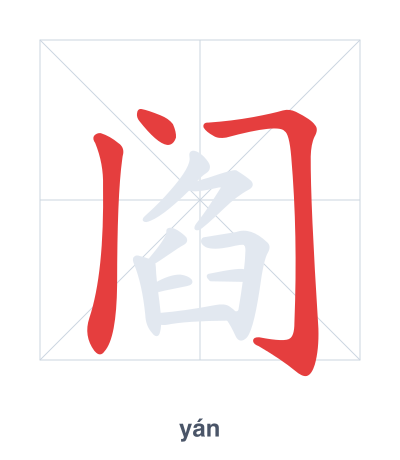
Open Hanzi Writer to see the animated stroke order and practice writing 阎 with real-time feedback.
The character 阎 (yán) is written with 11 strokes. Follow the standard Chinese stroke order: top to bottom, left to right, outside before inside. The radical 门 is one of its key components.
Practice the correct stroke order with the Hanzi Writer app to see animated stroke-by-stroke guidance with real-time feedback.
阎 means gate of a village; the surname Yan.
As an HSK Level 7 character, 阎 is an intermediate-level character.
阎 combines the radical 门 (gate) with 臽 (pit or trap). The original meaning is the inner gate of a village or lane—a gate that leads to an enclosed, sunken area within a settlement. Over time, it also became a common surname Yan.
💡 Memory Tip: Picture a village gate (门) with a trapdoor (臽) hidden just inside, so visitors must be careful entering the yard.
阎老师教我们中文。
yán lǎo shī jiào wǒ men zhōng wén
Teacher Yan teaches us Chinese.
民间传说里有阎王。
mín jiān chuán shuō lǐ yǒu yán wáng
There is a King of Hell in folklore.
阎罗是神话中的人物。
yán luó shì shén huà zhōng de rén wù
Yama is a character in mythology.
Open Hanzi Writer to see the animated stroke order and practice writing 阎 with real-time feedback.
✨ Animated stroke order · Handwriting recognition · HSK-graded practice · Free to use
阎 is composed of the radical 门 (gate) on the outside and the phonetic component 臽 (xiàn) on the inside. The outer 门 suggests a gate or entrance, which connects to the original meaning of a village gate. The inner part provides the pronunciation yán but does not directly contribute to the meaning.