老 (lǎo) means "old; elderly" in Chinese. It has 6 strokes with the radical 老, and is HSK Level 1.
Rated 2/5 in difficulty (beginner-friendly).
Harder than 20% of HSK Level 1 characters.
Appears in 3+ common words including 老师 (lǎo shī), 老人 (lǎo rén), 老家 (lǎo jiā).
In the Hanzi Writer app, most learners master 老 within 3 practice attempts using stroke-by-stroke animation.
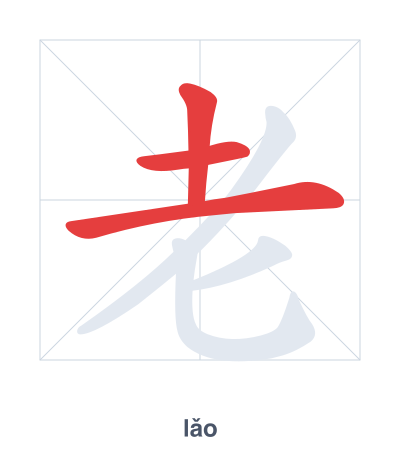
Open Hanzi Writer to see the animated stroke order and practice writing 老 with real-time feedback.
The character 老 (lǎo) is written with 6 strokes. Follow the standard Chinese stroke order: top to bottom, left to right, outside before inside. The radical 老 is one of its key components.
Practice the correct stroke order with the Hanzi Writer app to see animated stroke-by-stroke guidance with real-time feedback.
老 means old; elderly.
As an HSK Level 1 character, 老 is among the first characters beginners learn.
老 is a pictograph of an old person with long disheveled hair (top curves) and a bent back leaning on a walking stick (bottom right). In ancient oracle bone script, it depicted a hunched figure with a cane, directly representing the elderly.
💡 Memory Tip: Picture an old man with a curved back (the left side 土-like shape) using a cane (the right side 匕-like shape) to walk slowly.
老师在教室里。
lǎo shī zài jiào shì lǐ
The teacher is in the classroom.
那个老人很健康。
nà ge lǎo rén hěn jiàn kāng
That old man is very healthy.
我想回老家看看。
wǒ xiǎng huí lǎo jiā kàn kàn
I want to visit my hometown.
Open Hanzi Writer to see the animated stroke order and practice writing 老 with real-time feedback.
✨ Animated stroke order · Handwriting recognition · HSK-graded practice · Free to use
老 is made of two parts: the top part 耂 looks like an elderly person with bent back or long hair, and the bottom part 匕 originally represented a person turning or changing. Together they show the idea of a person who has aged over time.