闼 (tà) means "Door; inner door" in Chinese. It has 9 strokes with the radical 门.
Rated 4/5 in difficulty (challenging).
Appears in 3+ common words including 排闼 (pái tà), 闼门 (tà mén), 直闼 (zhí tà).
Due to its 9 strokes, Hanzi Writer's error detection shows 闼 requires focused practice — most learners need 10+ attempts for consistent accuracy.
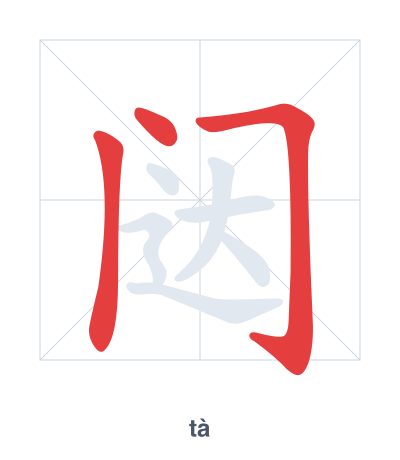
Open Hanzi Writer to see the animated stroke order and practice writing 闼 with real-time feedback.
The character 闼 (tà) is written with 9 strokes. Follow the standard Chinese stroke order: top to bottom, left to right, outside before inside. The radical 门 is one of its key components.
Practice the correct stroke order with the Hanzi Writer app to see animated stroke-by-stroke guidance with real-time feedback.
闼 means Door; inner door.
闼 is a compound character combining the radical 门 (door) with 达 (dá, meaning 'to reach' or 'to go through'). The door radical indicates the meaning relates to an entrance, while 达 adds the nuance of a passage leading inward, together signifying an inner door or small gate within a larger structure.
💡 Memory Tip: Picture a grand door (门) that, when you say 'ta-da!' and push it open, reveals a long passage (达) leading to the innermost room.
他推开排闼而入。
tā tuī kāi pái tà ér rù
He pushed open the door and entered.
这里的闼门很大。
zhè lǐ de tà mén hěn dà
The inner gates here are very large.
他直闼进屋子里。
tā zhí tà jìn wū zi lǐ
He burst straight into the room.
Open Hanzi Writer to see the animated stroke order and practice writing 闼 with real-time feedback.
✨ Animated stroke order · Handwriting recognition · HSK-graded practice · Free to use
闼 is made of the radical 门 (door) on the outside and the component 达 (to reach) on the inside. The 门 shows this character is about a door, while 达 suggests the idea of reaching or entering through that door. Together, they form the meaning of an inner door or a door that leads to an interior space.