寻 (xún) means "To seek; to look for." in Chinese. It has 6 strokes with the radical 彐, and is HSK Level 4.
Rated 3.2/5 in difficulty (challenging).
Harder than 20% of HSK Level 4 characters.
Appears in 3+ common words including 寻找 (xún zhǎo), 寻求 (xún qiú), 寻常 (xún cháng).
Due to its 6 strokes, Hanzi Writer's error detection shows 寻 requires focused practice — most learners need 10+ attempts for consistent accuracy.
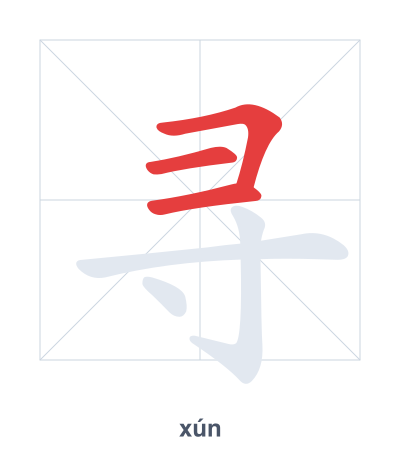
Open Hanzi Writer to see the animated stroke order and practice writing 寻 with real-time feedback.
The character 寻 (xún) is written with 6 strokes. Follow the standard Chinese stroke order: top to bottom, left to right, outside before inside. The radical 彐 is one of its key components.
Practice the correct stroke order with the Hanzi Writer app to see animated stroke-by-stroke guidance with real-time feedback.
寻 means To seek; to look for..
As an HSK Level 4 character, 寻 is an intermediate-level character.
寻 originally depicted a pair of outstretched hands (彐 and 寸) measuring a span, conveying the idea of searching or seeking by reaching out. Over time, the character simplified to combine a hand shape with another hand component, reinforcing the sense of actively looking for something.
💡 Memory Tip: Picture a hand (彐) measuring an inch (寸) as you diligently seek a hidden treasure.
他在寻找丢失的钥匙。
tā zài xún zhǎo diū shī de yào shi
He is looking for the lost keys.
我们在寻求帮助。
wǒ men zài xún qiú bāng zhù
We are seeking help.
这是一件寻常的小事。
zhè shì yī jiàn xún cháng de xiǎo shì
This is an ordinary little thing.
Open Hanzi Writer to see the animated stroke order and practice writing 寻 with real-time feedback.
✨ Animated stroke order · Handwriting recognition · HSK-graded practice · Free to use
寻 is composed of the radical 彐 (a hand) on top and 寸 (a hand with a measure) below. Together, they suggest using your hands to measure or reach out in order to seek something. This combination visually represents the action of searching with purposeful effort.