常 (cháng) means "Often / Frequent / Common" in Chinese. It has 11 strokes with the radical 巾, and is HSK Level 1.
Rated 3.7/5 in difficulty (challenging).
Harder than 85% of HSK Level 1 characters.
Appears in 3+ common words including 常常 (cháng cháng), 经常 (jīng cháng), 非常 (fēi cháng).
Due to its 11 strokes, Hanzi Writer's error detection shows 常 requires focused practice — most learners need 10+ attempts for consistent accuracy.
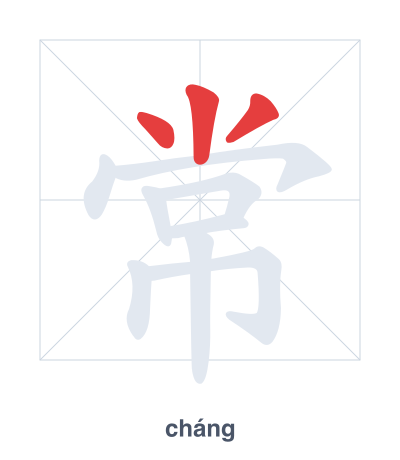
Open Hanzi Writer to see the animated stroke order and practice writing 常 with real-time feedback.
The character 常 (cháng) is written with 11 strokes. Follow the standard Chinese stroke order: top to bottom, left to right, outside before inside. The radical 巾 is one of its key components.
Practice the correct stroke order with the Hanzi Writer app to see animated stroke-by-stroke guidance with real-time feedback.
常 means Often / Frequent / Common.
As an HSK Level 1 character, 常 is among the first characters beginners learn.
常 originally depicted a lower garment (巾) worn regularly, and its phonetic component 尚 (meaning 'still' or 'yet') reinforced the sense of constancy. Over time, this association with regular use led to the extended meanings of 'often', 'frequent', and 'common'.
💡 Memory Tip: Picture a towel (巾) you still (尚) use every day—it's the one you often reach for.
我常常去书店。
wǒ cháng cháng qù shū diàn
I often go to the bookstore.
他经常锻炼身体。
tā jīng cháng duàn liàn shēn tǐ
He often exercises.
今天天气非常好。
jīn tiān tiān qì fēi cháng hǎo
The weather is excellent today.
Open Hanzi Writer to see the animated stroke order and practice writing 常 with real-time feedback.
✨ Animated stroke order · Handwriting recognition · HSK-graded practice · Free to use
常 is made of two parts: the top part 尚 (shàng) and the bottom part 巾 (cloth radical). Although the exact origin is unclear, the radical 巾 hints at everyday objects, and the character as a whole means 'often' or 'common'—something that is always present like a cloth you use daily.