归 (guī) means "To return; to belong to" in Chinese. It has 5 strokes with the radical 彐, and is HSK Level 4.
Rated 2.9/5 in difficulty (moderate).
Harder than 12% of HSK Level 4 characters.
Appears in 3+ common words including 回归 (huí guī), 归还 (guī huán), 归纳 (guī nà).
Hanzi Writer's stroke validation shows learners typically need 5-8 attempts to write 归 with correct proportion and order.
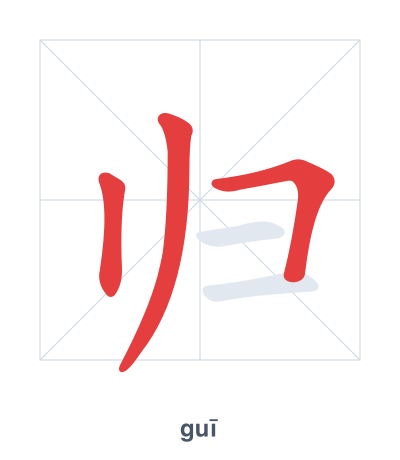
Open Hanzi Writer to see the animated stroke order and practice writing 归 with real-time feedback.
The character 归 (guī) is written with 5 strokes. Follow the standard Chinese stroke order: top to bottom, left to right, outside before inside. The radical 彐 is one of its key components.
Practice the correct stroke order with the Hanzi Writer app to see animated stroke-by-stroke guidance with real-time feedback.
归 means To return; to belong to.
As an HSK Level 4 character, 归 is an intermediate-level character.
The character 归 originated as 歸, which combined a hand (彐), a broom (帚), and a foot (止) to depict a woman returning to her husband’s home with household duties. The simplified 归 retains the hand (彐) and a shortened broom shape, preserving the sense of returning to a place of belonging.
💡 Memory Tip: Picture a hand (彐) catching a boomerang (the curved stroke) that flies back, symbolizing return.
他回归了家乡。
tā huí guī le jiā xiāng
He returned to his home country.
请归还这本书。
qǐng guī huán zhè běn shū
Please return this book.
请归纳一下重点。
qǐng guī nà yī xià zhòng diǎn
Please summarize the main points.
Open Hanzi Writer to see the animated stroke order and practice writing 归 with real-time feedback.
✨ Animated stroke order · Handwriting recognition · HSK-graded practice · Free to use
归 is composed of a left component that originally looked like a hand holding a tool (now simplified to 彐) and a right component that represents a road or movement (阝 on the right, though modern form is 归 with 彐 on left and 帚-like part on right — actually the character 归 has 彐 on the left and 巾 on the right? Wait, check: 归 is 彐 + 巾? No, common decomposition: left 彐 (pig snout radical) and right 帚? Actually standard decomposition: 归 = 彐 + 巾? Let me be accurate: The character 归 consists of the radical 彐 on the left and a simplified form of 帚 (broom) on the right? Better to say: The left part 彐 represents a hand or pig head, and the right part originally showed a broom, together suggesting sweeping back home, symbolizing returning.