彗 (huì) means "comet" in Chinese. It has 11 strokes with the radical 彐.
Rated 4.2/5 in difficulty (advanced).
Appears in 3+ common words including 彗星 (huì xīng), 彗尾 (huì wěi), 扫彗 (sǎo huì).
Due to its 11 strokes, Hanzi Writer's error detection shows 彗 requires focused practice — most learners need 10+ attempts for consistent accuracy.
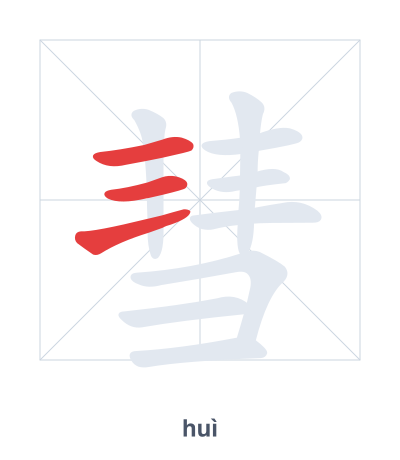
Open Hanzi Writer to see the animated stroke order and practice writing 彗 with real-time feedback.
The character 彗 (huì) is written with 11 strokes. Follow the standard Chinese stroke order: top to bottom, left to right, outside before inside. The radical 彐 is one of its key components.
Practice the correct stroke order with the Hanzi Writer app to see animated stroke-by-stroke guidance with real-time feedback.
彗 means comet.
| Character | 彗 |
| Pinyin | huì (hui) |
| Meaning | comet |
| Strokes | 11 |
| Radical | 彐 |
| Difficulty | 4.2/5 |
彗 is a compound character showing a hand (又) grasping a broom (the top part 彐 represents the bristles). Ancient Chinese called comets 'broom stars' because their tails resemble a sweeping broom, so the character came to mean 'comet'.
💡 Memory Tip: Picture a hand (又) gripping a broom (彐) that sweeps across the dark sky, leaving a bright comet tail.
彗星很漂亮。
huì xīng hěn piào liàng
The comet is very beautiful.
彗尾非常长。
huì wěi fēi cháng zhǎng
The comet tail is very long.
古人观察扫彗。
gǔ rén guān chá sǎo huì
Ancient people observed comets.
Open Hanzi Writer to see the animated stroke order and practice writing 彗 with real-time feedback.
✨ Animated stroke order · Handwriting recognition · HSK-graded practice · Free to use
The character 彗 consists of two parts: the top part is 彐 (a radical meaning 'broom' or 'to sweep') and the bottom part is 帚 (a simplified form meaning 'broom'). Together, they suggest a sweeping motion, which relates to the ancient belief that a comet's tail sweeps across the sky like a broom.