找 (zhǎo) means "to look for; to seek" in Chinese. It has 7 strokes with the radical 扌, and is HSK Level 1.
Rated 2.9/5 in difficulty (moderate).
Harder than 56% of HSK Level 1 characters.
Appears in 3+ common words including 找钱 (zhǎo qián), 找人 (zhǎo rén), 找到 (zhǎo dào).
Hanzi Writer's stroke validation shows learners typically need 5-8 attempts to write 找 with correct proportion and order.
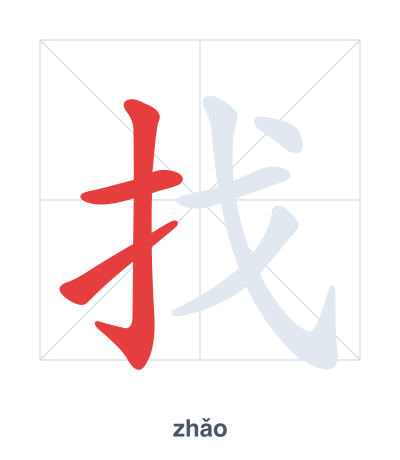
Open Hanzi Writer to see the animated stroke order and practice writing 找 with real-time feedback.
The character 找 (zhǎo) is written with 7 strokes. Follow the standard Chinese stroke order: top to bottom, left to right, outside before inside. The radical 扌 is one of its key components.
Practice the correct stroke order with the Hanzi Writer app to see animated stroke-by-stroke guidance with real-time feedback.
找 means to look for; to seek.
As an HSK Level 1 character, 找 is among the first characters beginners learn.
找 is a compound character combining the hand radical 扌 (hand) with 戈 (spear or dagger-axe). The image suggests using a hand to hold a spear while searching or probing, linking to the meaning 'to look for.' Historically, it was created to represent the act of seeking by actively handling a tool.
💡 Memory Tip: Imagine a hand (扌) holding a spear (戈) as you poke around to look for (找) something hidden in the grass.
收银员正在找钱。
shōu yín yuán zhèng zài zhǎo qián
The cashier is giving change.
那位戴眼镜的先生正在办公室门口找人。
nà wèi dài yǎn jìng de xiān shēng zhèng zài bàn gōng shì mén kǒu zhǎo rén 。
The gentleman wearing glasses is looking for someone at the office door.
我找到了我的手机。
wǒ zhǎo dào le wǒ de shǒu jī
I found my phone.
Open Hanzi Writer to see the animated stroke order and practice writing 找 with real-time feedback.
✨ Animated stroke order · Handwriting recognition · HSK-graded practice · Free to use
The left part is the radical 扌, meaning 'hand'. The right part is 戈, meaning 'spear' or 'weapon'. Together, they suggest using your hand to search or reach for something, like looking for an object.