录 (lù) means "To record; to tape" in Chinese. It has 8 strokes with the radical 彐, and is HSK Level 3.
Rated 3.7/5 in difficulty (challenging).
Harder than 49% of HSK Level 3 characters.
Appears in 3+ common words including 录音 (lù yīn), 记录 (jì lù), 录取 (lù qǔ).
Due to its 8 strokes, Hanzi Writer's error detection shows 录 requires focused practice — most learners need 10+ attempts for consistent accuracy.
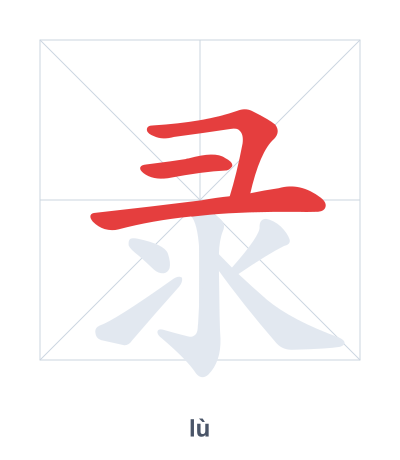
Open Hanzi Writer to see the animated stroke order and practice writing 录 with real-time feedback.
The character 录 (lù) is written with 8 strokes. Follow the standard Chinese stroke order: top to bottom, left to right, outside before inside. The radical 彐 is one of its key components.
Practice the correct stroke order with the Hanzi Writer app to see animated stroke-by-stroke guidance with real-time feedback.
录 means To record; to tape.
As an HSK Level 3 character, 录 is an intermediate-level character.
The ancient form of 录 (lù) originally depicted a wooden spindle used for winding thread, a tool for keeping count or recording information. Over time, the character evolved to its current structure, with the top component 彐 (a hand) and the bottom resembling a simplified version of the spindle or a recording device.
💡 Memory Tip: Picture a hand (彐) pressing a record button on a tape deck, with the lower part as the spinning reels (the 水-like shape) capturing sound.
我在听录音。
wǒ zài tīng lù yīn
I am listening to the recording.
请记录一下。
qǐng jì lù yī xià
Please take a record of it.
他被大学录取了。
tā bèi dà xué lù qǔ le
He was admitted to the university.
Open Hanzi Writer to see the animated stroke order and practice writing 录 with real-time feedback.
✨ Animated stroke order · Handwriting recognition · HSK-graded practice · Free to use
录 combines the radical 彐 (which resembles a hand or a brush) with 水 (water) in its ancient form, suggesting using a brush to record flowing ideas. Modernly, the top part is not 彐 but a stylized hand, and the bottom is 水, together implying capturing or writing down information.