彘 (zhì) means "pig (archaic)" in Chinese. It has 12 strokes with the radical 彐.
Rated 4.2/5 in difficulty (advanced).
Appears in 3+ common words including 彘肉 (zhì ròu), 狗彘 (gǒu zhì), 彘肩 (zhì jiān).
Due to its 12 strokes, Hanzi Writer's error detection shows 彘 requires focused practice — most learners need 10+ attempts for consistent accuracy.
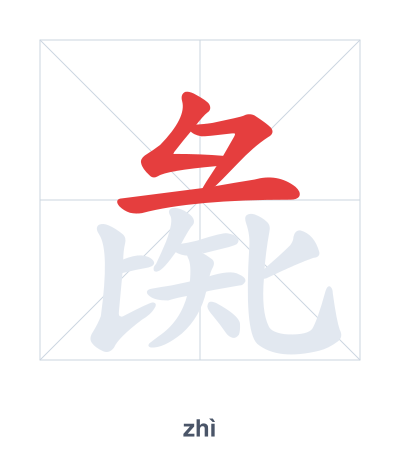
Open Hanzi Writer to see the animated stroke order and practice writing 彘 with real-time feedback.
The character 彘 (zhì) is written with 12 strokes. Follow the standard Chinese stroke order: top to bottom, left to right, outside before inside. The radical 彐 is one of its key components.
Practice the correct stroke order with the Hanzi Writer app to see animated stroke-by-stroke guidance with real-time feedback.
彘 means pig (archaic).
| Character | 彘 |
| Pinyin | zhì (zhi) |
| Meaning | pig (archaic) |
| Strokes | 12 |
| Radical | 彐 |
| Difficulty | 4.2/5 |
This character originally depicted a pig (豕) struck by an arrow (矢), representing a hunted wild boar. The top part (彐) is a stylized pig's head, and the bottom combines 矢 (arrow) with a variant of 匕 indicating a wound. Over time, the form simplified to 彘 as a generic archaic term for pig.
💡 Memory Tip: Picture a pig's snout (彐) pierced by an arrow (矢) — that sharp strike reminds you 彘 means 'pig' in old texts.
他喜欢吃彘肉。
tā xǐ huān chī zhì ròu
He likes eating pork.
这种行为如狗彘。
zhè zhǒng xíng wéi rú gǒu zhì
This behavior is like that of beasts.
这是一个彘肩。
zhè shì yí gè zhì jiān
This is a shoulder of pork.
Open Hanzi Writer to see the animated stroke order and practice writing 彘 with real-time feedback.
✨ Animated stroke order · Handwriting recognition · HSK-graded practice · Free to use
彘 is composed of three parts: the radical 彐 (a pig snout or head) at the top, 矢 (arrow) in the middle, and 匕 (spoon) at the bottom. Together they form an ancient pictograph of a pig, possibly showing a pig's head with an arrow and a spoon for cooking. The radical 彐 directly hints at the animal, while the other parts add phonetic or visual details.