装 (zhuāng) means "To pack; to install; outfit; to pretend" in Chinese. It has 12 strokes with the radical 衣, and is HSK Level 2.
Rated 3.7/5 in difficulty (challenging).
Harder than 94% of HSK Level 2 characters.
Appears in 3+ common words including 服装 (fú zhuāng), 包装 (bāo zhuāng), 安装 (ān zhuāng).
Due to its 12 strokes, Hanzi Writer's error detection shows 装 requires focused practice — most learners need 10+ attempts for consistent accuracy.
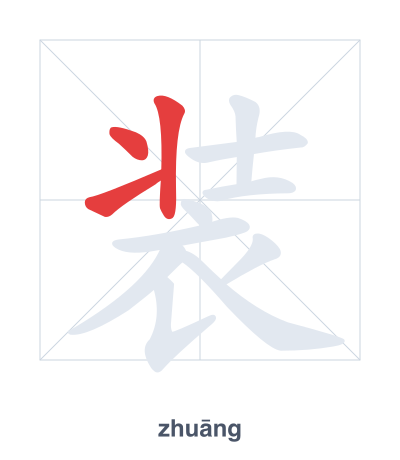
Open Hanzi Writer to see the animated stroke order and practice writing 装 with real-time feedback.
The character 装 (zhuāng) is written with 12 strokes. Follow the standard Chinese stroke order: top to bottom, left to right, outside before inside. The radical 衣 is one of its key components.
Practice the correct stroke order with the Hanzi Writer app to see animated stroke-by-stroke guidance with real-time feedback.
装 means To pack; to install; outfit; to pretend.
As an HSK Level 2 character, 装 is among the first characters beginners learn.
装 is a phono-semantic compound: 衣 (clothing) as the semantic component indicates the meaning relates to garments, while 壮 (zhuàng, 'strong') provides phonetic cues. It originally meant to pack or outfit oneself with clothing, later extending to installing and pretending (as in putting on a guise).
💡 Memory Tip: A strong man (壮) stuffs his clothes (衣) into a suitcase to pack, but he only pretends to go on a trip.
这家服装店很贵。
zhè jiā fú zhuāng diàn hěn guì
This clothing store is very expensive.
礼物的包装很精美。
lǐ wù de bāo zhuāng hěn jīng měi
The gift packaging is very exquisite.
师傅在安装空调。
shī fù zài ān zhuāng kōng tiáo
The technician is installing the air conditioner.
Open Hanzi Writer to see the animated stroke order and practice writing 装 with real-time feedback.
✨ Animated stroke order · Handwriting recognition · HSK-graded practice · Free to use
装 (zhuāng) combines the radical 衣 (clothing) on the bottom and the phonetic component 壮 (zhuàng, strong) on top. The radical 衣 connects to meanings like clothing or outfit, while 壮 hints at the pronunciation. Together, they create the idea of packing or installing, often involving garments or containers.