估 (gū/gù) means "To estimate or appraise." in Chinese. It has 7 strokes with the radical 亻, and is HSK Level 5.
Rated 3.2/5 in difficulty (challenging).
Harder than 11% of HSK Level 5 characters.
Appears in 3+ common words including 估计 (gū jì), 估算 (gū suàn), 估衣 (gù yī).
Due to its 7 strokes, Hanzi Writer's error detection shows 估 requires focused practice — most learners need 10+ attempts for consistent accuracy.
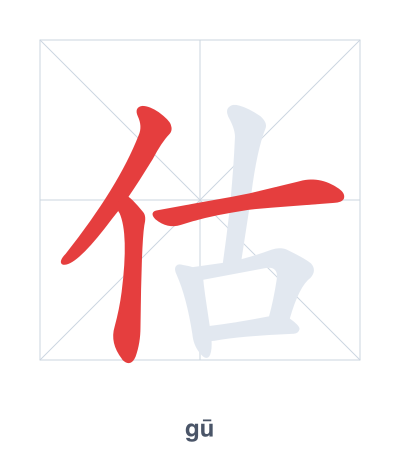
Open Hanzi Writer to see the animated stroke order and practice writing 估 with real-time feedback.
The character 估 (gū/gù) is written with 7 strokes. Follow the standard Chinese stroke order: top to bottom, left to right, outside before inside. The radical 亻 is one of its key components.
Practice the correct stroke order with the Hanzi Writer app to see animated stroke-by-stroke guidance with real-time feedback.
估 means To estimate or appraise..
This is a polyphonic character with readings: gū, gù.
As an HSK Level 5 character, 估 is an intermediate-level character.
估 combines the radical 亻 (person) with 古 (old). This suggests an elder or experienced person who can estimate or appraise the value of something based on age or experience. The character literally depicts 'a person assessing oldness' as a way to gauge worth.
💡 Memory Tip: Picture an old expert (古) using a magnifying glass (like the top of 古) to appraise a person's (亻) antique vase.
按照目前的进度估计,项目下周就能完工。
àn zhào mù qián de jìn dù gū jì xiàng mù xià zhōu jiù néng wán gōng
Based on the current progress, the project is estimated to be completed next week.
财务人员正在仔细估算这次活动的各项预算。
cái wù rén yuán zhèng zài zǐ xì gū suàn zhè cì huó dòng de gè xiàng yù suàn
The financial staff is carefully estimating the various budgets for this event.
巷子里那家卖旧衣服的小铺子叫估衣店。
xiàng zi lǐ nà jiā mài jiù yī fú de xiǎo pù zi jiào gù yī diàn
The small shop in the alley selling second-hand clothes is called a second-hand clothing store.
Open Hanzi Writer to see the animated stroke order and practice writing 估 with real-time feedback.
✨ Animated stroke order · Handwriting recognition · HSK-graded practice · Free to use
The character 估 consists of the radical 亻 (person) on the left and the component 古 (old) on the right. The radical shows that the action is done by a person, while 古 provides the sound (gǔ) and hints at the idea of age or experience, which connects to estimating value.