伲 (nì) means "We or I (used in some Chinese dialects like Shanghainese)." in Chinese. It has 7 strokes with the radical 亻.
Rated 3.2/5 in difficulty (challenging).
Appears in 3+ common words including 伲 (nì), 伲子 (nì zi), 伲家 (nì jiā).
Due to its 7 strokes, Hanzi Writer's error detection shows 伲 requires focused practice — most learners need 10+ attempts for consistent accuracy.
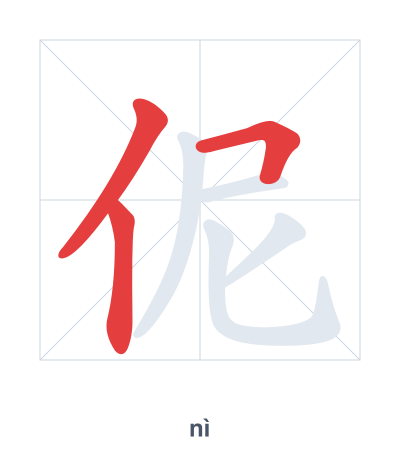
Open Hanzi Writer to see the animated stroke order and practice writing 伲 with real-time feedback.
The character 伲 (nì) is written with 7 strokes. Follow the standard Chinese stroke order: top to bottom, left to right, outside before inside. The radical 亻 is one of its key components.
Practice the correct stroke order with the Hanzi Writer app to see animated stroke-by-stroke guidance with real-time feedback.
伲 means We or I (used in some Chinese dialects like Shanghainese)..
伲 is a compound character with the person radical 亻 on the left, indicating a human reference, and 尼 on the right acting as a phonetic component (pronounced nì in dialects). It is a dialectal character used in Wu Chinese (like Shanghainese) to mean 'we' or 'I', formed by combining the idea of a person with a sound borrowed from 尼 (originally meaning 'nun' but used here only for its pronunciation).
💡 Memory Tip: Picture a person (亻) kneeling on one knee (尼 looks like a bent person) saying 'We (伲) kneel together!' to remember the dialect word for 'we'.
伲是上海话。
nì shì shàng hǎi huà
'Ni' is Shanghainese.
他有个伲子。
tā yǒu gè nì zi
He has a son.
伲家在上海。
nì jiā zài shàng hǎi
My family is in Shanghai.
Open Hanzi Writer to see the animated stroke order and practice writing 伲 with real-time feedback.
✨ Animated stroke order · Handwriting recognition · HSK-graded practice · Free to use
伲 is made of the radical 亻 (person) on the left, and the character 尼 (ní) on the right. The radical 亻 indicates that the meaning relates to people, while 尼 provides the sound. Since 伲 means 'I' or 'we' in some dialects, the left part hints at a person speaking.