雄 (xióng) means "male; grand; powerful" in Chinese. It has 12 strokes with the radical 隹, and is HSK Level 5.
Rated 4.2/5 in difficulty (advanced).
Harder than 98% of HSK Level 5 characters.
Appears in 3+ common words including 英雄 (yīng xióng), 雄伟 (xióng wěi), 雄性 (xióng xìng).
Due to its 12 strokes, Hanzi Writer's error detection shows 雄 requires focused practice — most learners need 10+ attempts for consistent accuracy.
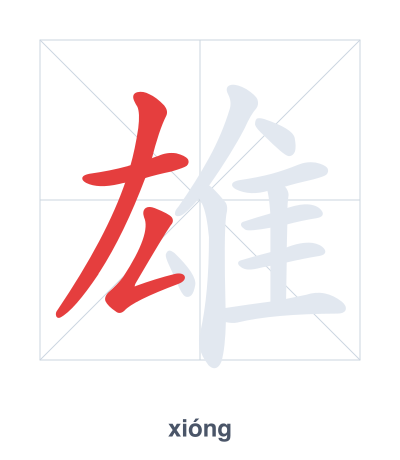
Open Hanzi Writer to see the animated stroke order and practice writing 雄 with real-time feedback.
The character 雄 (xióng) is written with 12 strokes. Follow the standard Chinese stroke order: top to bottom, left to right, outside before inside. The radical 隹 is one of its key components.
Practice the correct stroke order with the Hanzi Writer app to see animated stroke-by-stroke guidance with real-time feedback.
雄 means male; grand; powerful.
As an HSK Level 5 character, 雄 is an intermediate-level character.
雄 combines 厷 (a pictograph of a strong arm with a muscle bulge) and 隹 (short-tailed bird), originally depicting a male bird known for its strength and grand appearance. Over time, the meaning expanded to signify 'male,' 'grand,' or 'powerful' in a broader sense.
💡 Memory Tip: Picture a muscular bird (隹) flexing a huge arm (厷) to show it's the powerful male.
他是一个大英雄。
tā shì yí gè dà yīng xióng
He is a great hero.
长城非常雄伟。
cháng chéng fēi cháng xióng wěi
The Great Wall is very majestic.
这是一只雄性狮子。
zhè shì yī zhī xióng xìng shī zi
This is a male lion.
Open Hanzi Writer to see the animated stroke order and practice writing 雄 with real-time feedback.
✨ Animated stroke order · Handwriting recognition · HSK-graded practice · Free to use
雄 is a phono-semantic compound with left component 厷 (gōng, suggesting a strong arm) and right component 隹 (zhuī, meaning bird). Together they originally referred to a male bird, which extended to meanings like 'male,' 'grand,' and 'powerful.'