雁 (yàn) means "wild goose" in Chinese. It has 12 strokes with the radical 隹, and is HSK Level 7.
Rated 3.9/5 in difficulty (challenging).
Harder than 38% of HSK Level 7 characters.
Appears in 3+ common words including 大雁 (dà yàn), 雁群 (yàn qún), 归雁 (guī yàn).
Due to its 12 strokes, Hanzi Writer's error detection shows 雁 requires focused practice — most learners need 10+ attempts for consistent accuracy.
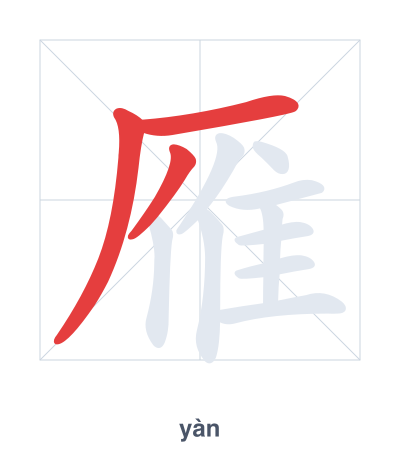
Open Hanzi Writer to see the animated stroke order and practice writing 雁 with real-time feedback.
The character 雁 (yàn) is written with 12 strokes. Follow the standard Chinese stroke order: top to bottom, left to right, outside before inside. The radical 隹 is one of its key components.
Practice the correct stroke order with the Hanzi Writer app to see animated stroke-by-stroke guidance with real-time feedback.
雁 means wild goose.
As an HSK Level 7 character, 雁 is an intermediate-level character.
雁 combines 厂 (cliff), 亻 (person), and 隹 (bird). It originally depicted a wild goose, likely because geese often rest on cliffs or fly in formations resembling a line of people.
💡 Memory Tip: Picture a person (亻) under a cliff (厂) pointing at a wild goose (隹) flying overhead.
秋天大雁往南飞。
qiū tiān dà yàn wǎng nán fēi
Wild geese fly south in autumn.
天空飞过一群雁群。
tiān kōng fēi guò yī qún yàn qún
A flock of wild geese flew across the sky.
春天是归雁的季节。
chūn tiān shì guī yàn de jì jié
Spring is the season for returning geese.
Open Hanzi Writer to see the animated stroke order and practice writing 雁 with real-time feedback.
✨ Animated stroke order · Handwriting recognition · HSK-graded practice · Free to use
雁 is made of 厂 (cliff) on top, 隹 (short-tailed bird) on right, and 人 (person) inside. The 隹 indicates it is a bird, and the 厂 plus 人 may suggest a bird that travels in groups or passes by cliffs, reflecting the wild goose's migratory nature.