雇 (gù) means "to hire; to employ" in Chinese. It has 12 strokes with the radical 隹, and is HSK Level 7.
Rated 4.2/5 in difficulty (advanced).
Harder than 96% of HSK Level 7 characters.
Appears in 3+ common words including 雇佣 (gù yōng), 雇主 (gù zhǔ), 雇员 (gù yuán).
Due to its 12 strokes, Hanzi Writer's error detection shows 雇 requires focused practice — most learners need 10+ attempts for consistent accuracy.
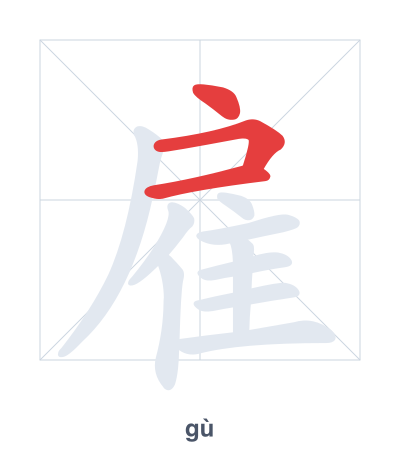
Open Hanzi Writer to see the animated stroke order and practice writing 雇 with real-time feedback.
The character 雇 (gù) is written with 12 strokes. Follow the standard Chinese stroke order: top to bottom, left to right, outside before inside. The radical 隹 is one of its key components.
Practice the correct stroke order with the Hanzi Writer app to see animated stroke-by-stroke guidance with real-time feedback.
雇 means to hire; to employ.
As an HSK Level 7 character, 雇 is an intermediate-level character.
雇 combines 户 (door/household) and 隹 (short-tailed bird). The image of a bird arriving at a door suggests seeking a place to stay, which evolved into the concept of hiring or employing a person for work.
💡 Memory Tip: Picture a homeowner opening the door (户) to hire a talking bird (隹) as a receptionist.
公司雇佣了新员工。
gōng sī gù yōng le xīn yuán gōng
The company hired new employees.
他是一个好雇主。
tā shì yí gè hǎo gù zhǔ
He is a good employer.
店里有三名雇员。
diàn lǐ yǒu sān míng gù yuán
There are three employees in the shop.
Open Hanzi Writer to see the animated stroke order and practice writing 雇 with real-time feedback.
✨ Animated stroke order · Handwriting recognition · HSK-graded practice · Free to use
雇 is made of 户 (door/house) on top and 隹 (short-tailed bird) below. The image of a bird entering a house suggests the idea of bringing someone into your home or workplace, which evolved into meaning 'to hire' or 'to employ'.