伟 (wěi) means "Great; grand; extraordinary." in Chinese. It has 6 strokes with the radical 亻, and is HSK Level 3.
Rated 2.9/5 in difficulty (moderate).
Harder than 18% of HSK Level 3 characters.
Appears in 3+ common words including 伟大 (wěi dà), 伟人 (wěi rén), 雄伟 (xióng wěi).
Hanzi Writer's stroke validation shows learners typically need 5-8 attempts to write 伟 with correct proportion and order.
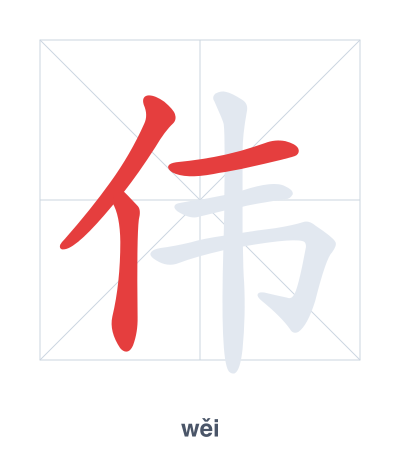
Open Hanzi Writer to see the animated stroke order and practice writing 伟 with real-time feedback.
The character 伟 (wěi) is written with 6 strokes. Follow the standard Chinese stroke order: top to bottom, left to right, outside before inside. The radical 亻 is one of its key components.
Practice the correct stroke order with the Hanzi Writer app to see animated stroke-by-stroke guidance with real-time feedback.
伟 means Great; grand; extraordinary..
As an HSK Level 3 character, 伟 is an intermediate-level character.
伟 is a phono-semantic compound character. The radical 亻 (person) indicates a human, while the phonetic component 韦 (wěi) suggests the sound and originally depicted a leather hide or enclosure. Together, they convey the idea of a person who is grand or extraordinary, like someone of remarkable stature or achievement.
💡 Memory Tip: Imagine a great person (亻) climbing a ladder (韦) to reach extraordinary heights.
母亲是很伟大的。
mǔ qīn shì hěn wěi dà de
Mothers are great.
我们要学习伟人的精神。
wǒ men yào xué xí wěi rén de jīng shén
We should learn from the spirit of great people.
长城非常雄伟。
cháng chéng fēi cháng xióng wěi
The Great Wall is very majestic.
Open Hanzi Writer to see the animated stroke order and practice writing 伟 with real-time feedback.
✨ Animated stroke order · Handwriting recognition · HSK-graded practice · Free to use
伟 is made of the radical 亻 (person) on the left and 韦 on the right. 亻 shows the meaning is related to people, and 韦 originally meant "leather" but here acts as a phonetic component indicating the sound wěi. Together, the character suggests a person who is extraordinary or great.