隺 (hú) means "crane; white (rare variant)" in Chinese. It has 10 strokes with the radical 隹.
Rated 4.2/5 in difficulty (advanced).
Appears in 3+ common words including 隺立 (hú lì), 隺然 (hú rán), 隺望 (hú wàng).
Due to its 10 strokes, Hanzi Writer's error detection shows 隺 requires focused practice — most learners need 10+ attempts for consistent accuracy.
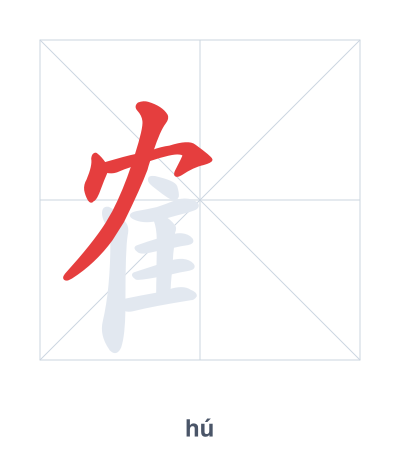
Open Hanzi Writer to see the animated stroke order and practice writing 隺 with real-time feedback.
The character 隺 (hú) is written with 10 strokes. Follow the standard Chinese stroke order: top to bottom, left to right, outside before inside. The radical 隹 is one of its key components.
Practice the correct stroke order with the Hanzi Writer app to see animated stroke-by-stroke guidance with real-time feedback.
隺 means crane; white (rare variant).
| Character | 隺 |
| Pinyin | hú (hu) |
| Meaning | crane; white (rare variant) |
| Strokes | 10 |
| Radical | 隹 |
| Difficulty | 4.2/5 |
隺 is an ancient pictograph of a crane, showing a long neck and crest (the top part) above the bird radical 隹, which identifies it as a bird. This simpler form later evolved into 鶴, but originally it directly depicted the crane's distinctive silhouette.
💡 Memory Tip: Imagine a crane with a tall, curved neck (the top strokes) standing proudly on a bird-shaped body (隹) – that's this crane character.
他在山顶隺立。
tā zài shān dǐng hú lì
He stands tall on the mountaintop.
他的样子很隺然。
tā de yàng zi hěn hú rán
He looks very tall and lean.
他在隺望故乡。
tā zài hú wàng gù xiāng
He is looking towards his hometown from afar.
Open Hanzi Writer to see the animated stroke order and practice writing 隺 with real-time feedback.
✨ Animated stroke order · Handwriting recognition · HSK-graded practice · Free to use
隺 consists of the radical 隹 (bird) on top and the component 冖 (cover) below. The bird radical relates to the meaning "crane," while the cover shape suggests a bird standing tall or sheltered, reinforcing the image of a crane's upright posture.