熊 (xióng) means "bear" in Chinese. It has 14 strokes with the radical 灬, and is HSK Level 5.
Rated 4.2/5 in difficulty (advanced).
Harder than 80% of HSK Level 5 characters.
Appears in 3+ common words including 熊猫 (xióng māo), 狗熊 (gǒu xióng), 熊熊大火 (xióng xióng dà huǒ).
Due to its 14 strokes, Hanzi Writer's error detection shows 熊 requires focused practice — most learners need 10+ attempts for consistent accuracy.
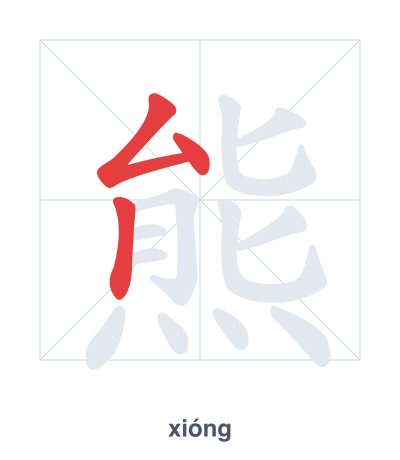
Open Hanzi Writer to see the animated stroke order and practice writing 熊 with real-time feedback.
The character 熊 (xióng) is written with 14 strokes. Follow the standard Chinese stroke order: top to bottom, left to right, outside before inside. The radical 灬 is one of its key components.
Practice the correct stroke order with the Hanzi Writer app to see animated stroke-by-stroke guidance with real-time feedback.
熊 means bear.
As an HSK Level 5 character, 熊 is an intermediate-level character.
熊 combines 能 (originally a pictograph of a bear in ancient scripts) with the fire radical 灬 to emphasize the bear's fierce, fiery nature or its mythical connection to fire.
💡 Memory Tip: Picture a bear (能) warming its paws over a glowing fire (灬) in the forest.
熊猫是中国的国宝。
xióng māo shì zhōng guó de guó bǎo
Pandas are the national treasure of China.
动物园里有一只狗熊。
dòng wù yuán lǐ yǒu yī zhī gǒu xióng
There is a black bear in the zoo.
远处燃起了熊熊大火。
yuǎn chù rán qǐ le xióng xióng dà huǒ
A raging fire broke out in the distance.
Open Hanzi Writer to see the animated stroke order and practice writing 熊 with real-time feedback.
✨ Animated stroke order · Handwriting recognition · HSK-graded practice · Free to use
熊 has a top part 能 (which originally showed a bear's shape) and a bottom radical 灬 (fire). The combination suggests something bear-like or powerful, but the fire radical is actually a phonetic hint or a later addition. The core meaning is "bear."