狗 (gǒu) means "Dog" in Chinese. It has 8 strokes with the radical 犭, and is HSK Level 2.
Rated 3.2/5 in difficulty (challenging).
Harder than 51% of HSK Level 2 characters.
Appears in 3+ common words including 小狗 (xiǎo gǒu), 狗粮 (gǒu liáng), 喂狗 (wèi gǒu).
Due to its 8 strokes, Hanzi Writer's error detection shows 狗 requires focused practice — most learners need 10+ attempts for consistent accuracy.
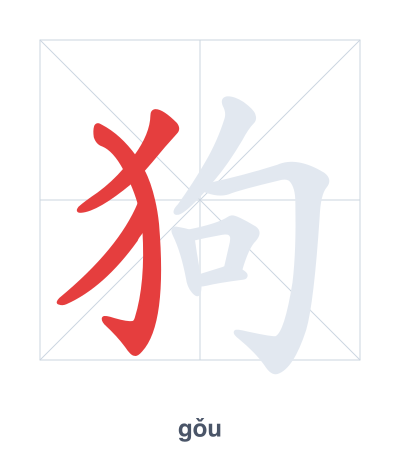
Open Hanzi Writer to see the animated stroke order and practice writing 狗 with real-time feedback.
The character 狗 (gǒu) is written with 8 strokes. Follow the standard Chinese stroke order: top to bottom, left to right, outside before inside. The radical 犭 is one of its key components.
Practice the correct stroke order with the Hanzi Writer app to see animated stroke-by-stroke guidance with real-time feedback.
狗 means Dog.
As an HSK Level 2 character, 狗 is among the first characters beginners learn.
The character 狗 combines the radical 犭, a simplified pictograph of a dog, with the phonetic component 句 (gōu), which provides the sound. In ancient oracle bones, the dog was depicted with a curled tail and standing profile. This structure creates a phono-semantic compound where the meaning comes from the radical and the pronunciation from the phonetic.
💡 Memory Tip: Picture a dog (犭) sitting next to a speech bubble (句) — it's the dog that listens to every word you say.
我家有一只小狗。
wǒ jiā yǒu yī zhī xiǎo gǒu
My family has a puppy.
我去超市买狗粮。
wǒ qù chāo shì mǎi gǒu liáng
I'm going to the supermarket to buy dog food.
他每天早晚都会准时去后院喂狗。
tā měi tiān zǎo wǎn dū huì zhǔn shí qù hòu yuàn wèi gǒu 。
He goes to the backyard to feed the dog on time every morning and evening.
Open Hanzi Writer to see the animated stroke order and practice writing 狗 with real-time feedback.
✨ Animated stroke order · Handwriting recognition · HSK-graded practice · Free to use
The left side 犭 is the animal radical, indicating the character relates to animals, especially dogs. The right side 句 provides a clue to pronunciation (gǒu) and originally may have represented a dog's curled tail or posture, but today it mainly acts as a phonetic component.