焉 (yān) means "how / where (classical)" in Chinese. It has 11 strokes with the radical 灬.
Rated 4.2/5 in difficulty (advanced).
Appears in 3+ common words including 心不在焉 (xīn bù zài yān), 焉能 (yān néng), 终焉 (zhōng yān).
Due to its 11 strokes, Hanzi Writer's error detection shows 焉 requires focused practice — most learners need 10+ attempts for consistent accuracy.
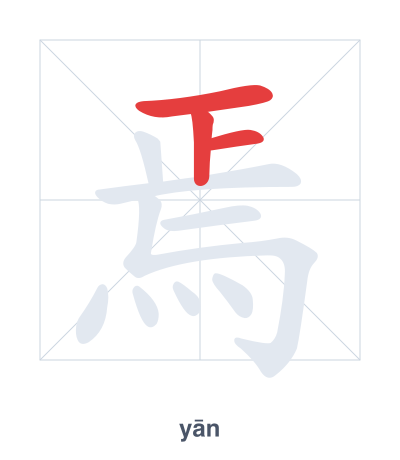
Open Hanzi Writer to see the animated stroke order and practice writing 焉 with real-time feedback.
The character 焉 (yān) is written with 11 strokes. Follow the standard Chinese stroke order: top to bottom, left to right, outside before inside. The radical 灬 is one of its key components.
Practice the correct stroke order with the Hanzi Writer app to see animated stroke-by-stroke guidance with real-time feedback.
焉 means how / where (classical).
| Character | 焉 |
| Pinyin | yān (yan) |
| Meaning | how / where (classical) |
| Strokes | 11 |
| Radical | 灬 |
| Difficulty | 4.2/5 |
In ancient oracle bone script, 焉 depicted a bird with a long, graceful tail, serving as a pictograph. It was later borrowed to represent the classical question words 'how' and 'where' due to sound similarity, leaving the original bird meaning behind. The modern form's bottom radical 灬 (fire) is a visual distortion of the bird's tail feathers, not fire itself.
💡 Memory Tip: Picture a bird (the top part looks like a bird's head and wings) standing on fire (灬) and thinking, 'How did I get here, and where can I escape?'
他上课时总是心不在焉。
tā shàng kè shí zǒng shì xīn bù zài yān
He is always absent-minded in class.
我焉能不知道这件事?
wǒ yān néng bù zhī dào zhè jiàn shì
How could I not know about this?
故事终于迎来了终焉。
gù shì zhōng yú yíng lái le zhōng yān
The story finally reached its conclusion.
Open Hanzi Writer to see the animated stroke order and practice writing 焉 with real-time feedback.
✨ Animated stroke order · Handwriting recognition · HSK-graded practice · Free to use
焉 is made of a horizontal line, 口 (mouth), and 羽 (feather) above the fire radical 灬. The components do not directly reveal its classical meanings of 'how' or 'where,' because 焉 is a phonetic loan character. The fire radical at the bottom is a common element but unrelated to the meaning.