胁 (xié) means "Flank / Side of the body" in Chinese. It has 8 strokes with the radical 月, and is HSK Level 6.
Rated 3.7/5 in difficulty (challenging).
Harder than 34% of HSK Level 6 characters.
Appears in 3+ common words including 威胁 (wēi xié), 胁迫 (xié pò), 胁骨 (xié gǔ).
Due to its 8 strokes, Hanzi Writer's error detection shows 胁 requires focused practice — most learners need 10+ attempts for consistent accuracy.
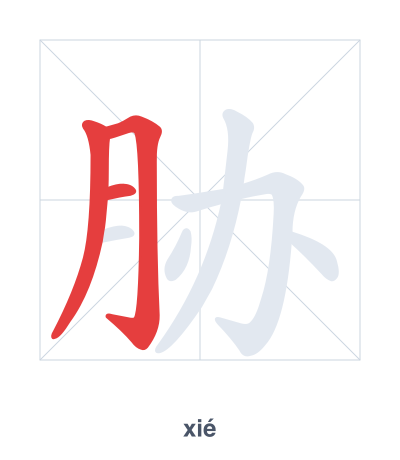
Open Hanzi Writer to see the animated stroke order and practice writing 胁 with real-time feedback.
The character 胁 (xié) is written with 8 strokes. Follow the standard Chinese stroke order: top to bottom, left to right, outside before inside. The radical 月 is one of its key components.
Practice the correct stroke order with the Hanzi Writer app to see animated stroke-by-stroke guidance with real-time feedback.
胁 means Flank / Side of the body.
As an HSK Level 6 character, 胁 is an intermediate-level character.
This character is a phono-semantic compound: the radical 月 (flesh/body) indicates it relates to the body, and the component 劦 (xié) provides the sound. Together, they refer to the side of the torso, specifically the ribs and flank area.
💡 Memory Tip: Picture three strong forces (劦) pressing into the side of a body (月) — that's your vulnerable flank area.
他威胁要离开公司。
tā wēi xié yào lí kāi gōng sī
He threatened to leave the company.
他是被胁迫才做的。
tā shì bèi xié pò cái zuò de
He did it because he was coerced.
他的胁骨受伤了。
tā de xié gǔ shòu shāng le
His ribs are injured.
Open Hanzi Writer to see the animated stroke order and practice writing 胁 with real-time feedback.
✨ Animated stroke order · Handwriting recognition · HSK-graded practice · Free to use
The left side is the radical 月 (肉), meaning "flesh" or "body part." The right side is 办 (bàn, meaning "to manage" or "to do"), which gives a phonetic hint. Together, they suggest a part of the body—specifically the flank or ribs—that is involved in movement or action.