垢 (gòu) means "dirt; filth" in Chinese. It has 9 strokes with the radical 土.
Rated 4/5 in difficulty (challenging).
Appears in 3+ common words including 污垢 (wū gòu), 牙垢 (yá gòu), 油垢 (yóu gòu).
Due to its 9 strokes, Hanzi Writer's error detection shows 垢 requires focused practice — most learners need 10+ attempts for consistent accuracy.
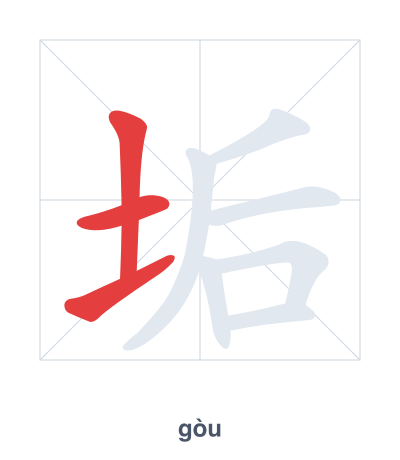
Open Hanzi Writer to see the animated stroke order and practice writing 垢 with real-time feedback.
The character 垢 (gòu) is written with 9 strokes. Follow the standard Chinese stroke order: top to bottom, left to right, outside before inside. The radical 土 is one of its key components.
Practice the correct stroke order with the Hanzi Writer app to see animated stroke-by-stroke guidance with real-time feedback.
垢 means dirt; filth.
垢 combines the radical 土 (earth/soil) with 后 (hòu, 'behind' or 'after'), suggesting dirt that accumulates on the ground or is left behind after something. The soil radical directly connects to earthiness and filth, while 后 implies residual grime that sticks and remains.
💡 Memory Tip: Picture a muddy footprint (土) left behind (后) on a clean floor—that's the dirt (垢) you need to clean up.
衣服上有很多污垢。
yī fú shàng yǒu hěn duō wū gòu
There is a lot of dirt on the clothes.
每天刷牙能去牙垢。
měi tiān shuā yá néng qù yá gòu
Brushing teeth every day can remove plaque.
厨房里到处是油垢。
chú fáng lǐ dào chù shì yóu gòu
There is grease everywhere in the kitchen.
Open Hanzi Writer to see the animated stroke order and practice writing 垢 with real-time feedback.
✨ Animated stroke order · Handwriting recognition · HSK-graded practice · Free to use
The character 垢 is composed of the radical 土 (earth/soil) on the left and the phonetic component 后 (hòu, behind/after) on the right. The radical 土 suggests a connection to earth or dirt, while 后 provides a clue to pronunciation. Together, they convey the idea of dirt or filth, often referring to grime that sticks to surfaces.