娃 (wá) means "baby" in Chinese. It has 9 strokes with the radical 女, and is HSK Level 6.
Rated 4/5 in difficulty (challenging).
Harder than 45% of HSK Level 6 characters.
Appears in 3+ common words including 娃娃 (wá wá), 娃哈哈 (wá hā hā), 女娃 (nǚ wá).
Due to its 9 strokes, Hanzi Writer's error detection shows 娃 requires focused practice — most learners need 10+ attempts for consistent accuracy.
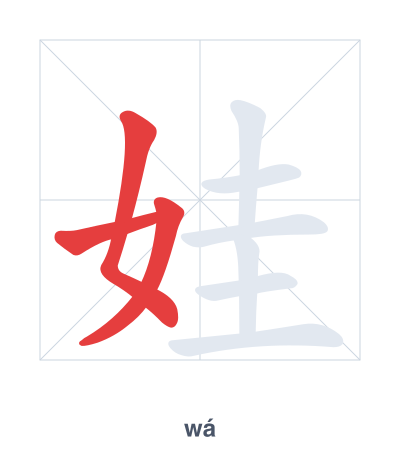
Open Hanzi Writer to see the animated stroke order and practice writing 娃 with real-time feedback.
The character 娃 (wá) is written with 9 strokes. Follow the standard Chinese stroke order: top to bottom, left to right, outside before inside. The radical 女 is one of its key components.
Practice the correct stroke order with the Hanzi Writer app to see animated stroke-by-stroke guidance with real-time feedback.
娃 means baby.
As an HSK Level 6 character, 娃 is an intermediate-level character.
The character 娃 combines the radical 女 (woman) with the phonetic component 圭 (a jade scepter). Originally referring to a beautiful woman, it later extended to mean 'baby,' reflecting the close association between women and infants.
💡 Memory Tip: Imagine a woman (女) holding a jade scepter (圭) that magically transforms into a cooing baby.
妹妹喜欢洋娃娃。
mèi mèi xǐ huān yáng wá wá
The younger sister likes dolls.
我爱喝娃哈哈饮料。
wǒ ài hē wá hā hā yǐn liào
I love drinking Wahaha drinks.
那个小女娃很可爱。
nà ge xiǎo nǚ wá hěn kě ài
That little girl is very cute.
Open Hanzi Writer to see the animated stroke order and practice writing 娃 with real-time feedback.
✨ Animated stroke order · Handwriting recognition · HSK-graded practice · Free to use
娃 combines the radical 女 (woman/female) on the left with 圭 (guī) on the right. 女 indicates that the character relates to females or children, while 圭 provides the pronunciation (wá). So 娃 originally meant a baby girl, and now generally means baby or doll.