徒 (tú) means "Follower / apprentice / on foot" in Chinese. It has 10 strokes with the radical 彳, and is HSK Level 6.
Rated 4.2/5 in difficulty (advanced).
Harder than 58% of HSK Level 6 characters.
Appears in 3+ common words including 徒弟 (tú dì), 徒步 (tú bù), 徒劳 (tú láo).
Due to its 10 strokes, Hanzi Writer's error detection shows 徒 requires focused practice — most learners need 10+ attempts for consistent accuracy.
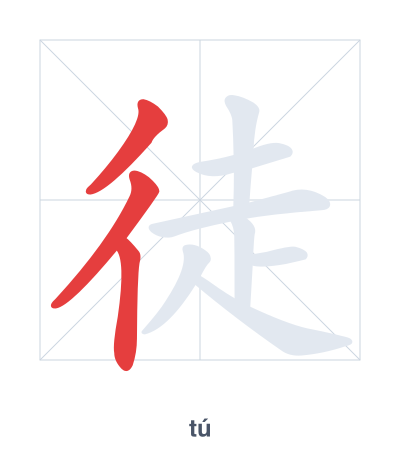
Open Hanzi Writer to see the animated stroke order and practice writing 徒 with real-time feedback.
The character 徒 (tú) is written with 10 strokes. Follow the standard Chinese stroke order: top to bottom, left to right, outside before inside. The radical 彳 is one of its key components.
Practice the correct stroke order with the Hanzi Writer app to see animated stroke-by-stroke guidance with real-time feedback.
徒 means Follower / apprentice / on foot.
As an HSK Level 6 character, 徒 is an intermediate-level character.
The character 徒 combines the walking radical 彳 (step) with 土 (earth) and 止 (foot), originally depicting someone traveling on foot over land. This literal meaning of 'going on foot' extended to a follower or apprentice who walks alongside a teacher or master.
💡 Memory Tip: Picture a pair of footprints (彳) stomping on dirt (土) with a big toe (止) sticking out — this is a loyal apprentice trudging behind his master.
他是我的徒弟。
tā shì wǒ de tú dì
He is my apprentice.
我们去徒步旅行。
wǒ men qù tú bù lǚ xíng
Let's go hiking.
这样做是徒劳的。
zhè yàng zuò shì tú láo de
Doing this is futile.
Open Hanzi Writer to see the animated stroke order and practice writing 徒 with real-time feedback.
✨ Animated stroke order · Handwriting recognition · HSK-graded practice · Free to use
The character 徒 is composed of the radical 彳 (meaning 'step' or 'walk') on the left, and the component 走 (meaning 'walk' or 'run') on the right. Together, they emphasize the idea of walking or moving on foot, which is the original meaning. The meaning 'follower' or 'apprentice' comes from the image of a person walking behind a master.