弟 (dì) means "younger brother" in Chinese. It has 7 strokes with the radical 弓, and is HSK Level 1.
Rated 2.9/5 in difficulty (moderate).
Harder than 54% of HSK Level 1 characters.
Appears in 3+ common words including 弟弟 (dì di), 兄弟 (xiōng dì), 弟子 (dì zǐ).
Hanzi Writer's stroke validation shows learners typically need 5-8 attempts to write 弟 with correct proportion and order.
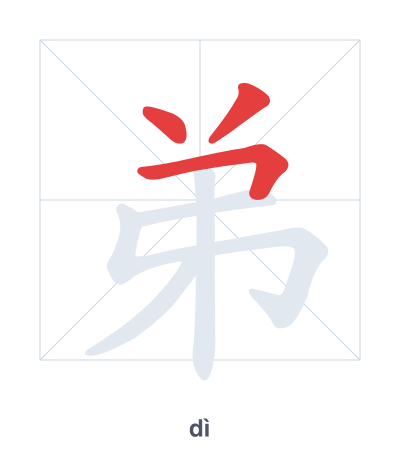
Open Hanzi Writer to see the animated stroke order and practice writing 弟 with real-time feedback.
The character 弟 (dì) is written with 7 strokes. Follow the standard Chinese stroke order: top to bottom, left to right, outside before inside. The radical 弓 is one of its key components.
Practice the correct stroke order with the Hanzi Writer app to see animated stroke-by-stroke guidance with real-time feedback.
弟 means younger brother.
As an HSK Level 1 character, 弟 is among the first characters beginners learn.
弟 originally depicted a rope twisted around a pole, symbolizing order or sequence. It was later borrowed phonetically to mean 'younger brother,' and the radical 弓 (bow) became part of its modern form, though it does not directly relate to the meaning.
💡 Memory Tip: Picture your younger brother trying to bend a bow (弓) while standing on two dots (丷) as stools to reach the string, looking silly.
我有一个弟弟。
wǒ yǒu yí gè dì di
I have a younger brother.
他们是好兄弟。
tā men shì hǎo xiōng dì
They are good brothers.
他是老师的弟子。
tā shì lǎo shī de dì zǐ
He is the teacher's disciple.
Open Hanzi Writer to see the animated stroke order and practice writing 弟 with real-time feedback.
✨ Animated stroke order · Handwriting recognition · HSK-graded practice · Free to use
弟 (dì) is composed of the radical 弓 (bow) on the left and a vertical stroke with small strokes on the right. The original form showed a rope or cord being wound around a support, which evolved to represent the idea of a younger brother, as in a sequence or order.