替 (tì) means "For / on behalf of / replace" in Chinese. It has 12 strokes with the radical 曰, and is HSK Level 4.
Rated 3.9/5 in difficulty (challenging).
Harder than 54% of HSK Level 4 characters.
Appears in 3+ common words including 代替 (dài tì), 替身 (tì shēn), 替我 (tì wǒ).
Due to its 12 strokes, Hanzi Writer's error detection shows 替 requires focused practice — most learners need 10+ attempts for consistent accuracy.
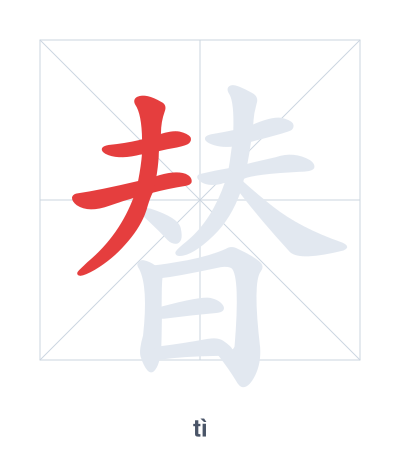
Open Hanzi Writer to see the animated stroke order and practice writing 替 with real-time feedback.
The character 替 (tì) is written with 12 strokes. Follow the standard Chinese stroke order: top to bottom, left to right, outside before inside. The radical 曰 is one of its key components.
Practice the correct stroke order with the Hanzi Writer app to see animated stroke-by-stroke guidance with real-time feedback.
替 means For / on behalf of / replace.
As an HSK Level 4 character, 替 is an intermediate-level character.
替 combines 曰 (to speak) and 竝 (two persons side by side), originally depicting one person speaking on behalf of another, hence the meaning 'for, on behalf of, replace'.
💡 Memory Tip: Picture two persons (竝) with a mouth (曰) between them – one speaks for the other, effectively replacing their voice.
没人能代替你。
méi rén néng dài tì nǐ
No one can replace you.
他是一个替身演员。
tā shì yí gè tì shēn yǎn yuán
He is a stunt double.
请替我向他问好。
qǐng tì wǒ xiàng tā wèn hǎo
Please say hello to him for me.
Open Hanzi Writer to see the animated stroke order and practice writing 替 with real-time feedback.
✨ Animated stroke order · Handwriting recognition · HSK-graded practice · Free to use
替 is composed of two 夫 (fū, husband/man) stacked vertically, with a 曰 (yuē, say) component on top. The top part 曰 suggests speaking or doing, while the two 夫 imply two people taking turns—this visually represents one person acting for or replacing another.