曰 (yuē) means "to say / speak (classical)" in Chinese. It has 4 strokes with the radical 曰, and is HSK Level 7.
Rated 2.4/5 in difficulty (moderate).
Harder than 2% of HSK Level 7 characters.
Appears in 3+ common words including 子曰 (zi yuē), 诗云子曰 (shī yún zi yuē), 美其名曰 (měi qí míng yuē).
Hanzi Writer's stroke validation shows learners typically need 5-8 attempts to write 曰 with correct proportion and order.
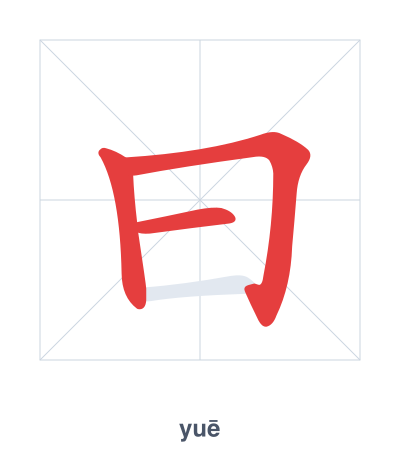
Open Hanzi Writer to see the animated stroke order and practice writing 曰 with real-time feedback.
The character 曰 (yuē) is written with 4 strokes. Follow the standard Chinese stroke order: top to bottom, left to right, outside before inside. The radical 曰 is one of its key components.
Practice the correct stroke order with the Hanzi Writer app to see animated stroke-by-stroke guidance with real-time feedback.
曰 means to say / speak (classical).
As an HSK Level 7 character, 曰 is an intermediate-level character.
曰 is a pictograph of a mouth with a tongue or a line of speech coming out. In ancient oracle bone script, it resembled a mouth (口) with a horizontal line above, indicating words being spoken. This visually connects to its meaning 'to say' in classical Chinese.
💡 Memory Tip: Imagine a mouth (口) with a flat line over it, like a cartoon character's speech bubble without the bubble — just the words coming out as a straight line.
子曰:学而时习之。
zi yuē xué ér shí xí zhī
Confucius said: 'To learn and at due times to practice what one has learned.'
他总是诗云子曰。
tā zǒng shì shī yún zi yuē
He is always quoting the classics pedantically.
美其名曰艺术。
měi qí míng yuē yì shù
Euphemistically called art.
Open Hanzi Writer to see the animated stroke order and practice writing 曰 with real-time feedback.
✨ Animated stroke order · Handwriting recognition · HSK-graded practice · Free to use
曰 is a pictograph of a mouth with a tongue or breath line inside, representing speech. It is its own radical and does not break down into smaller meaningful parts. Its shape directly conveys the action of speaking in classical Chinese.