曷 (hé) means "why / how (classical)" in Chinese. It has 9 strokes with the radical 曰.
Rated 3.7/5 in difficulty (challenging).
Appears in 3+ common words including 曷 (hé), 曷胜 (hé shèng), 曷尝 (hé cháng).
Due to its 9 strokes, Hanzi Writer's error detection shows 曷 requires focused practice — most learners need 10+ attempts for consistent accuracy.
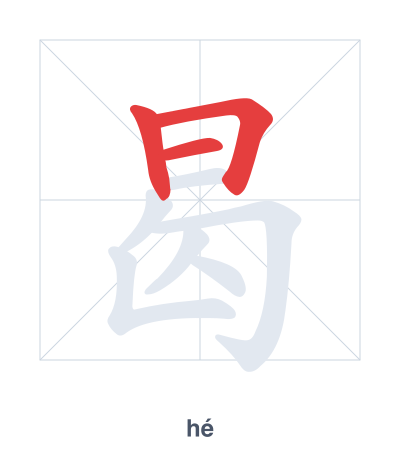
Open Hanzi Writer to see the animated stroke order and practice writing 曷 with real-time feedback.
The character 曷 (hé) is written with 9 strokes. Follow the standard Chinese stroke order: top to bottom, left to right, outside before inside. The radical 曰 is one of its key components.
Practice the correct stroke order with the Hanzi Writer app to see animated stroke-by-stroke guidance with real-time feedback.
曷 means why / how (classical).
| Character | 曷 |
| Pinyin | hé (he) |
| Meaning | why / how (classical) |
| Strokes | 9 |
| Radical | 曰 |
| Difficulty | 3.7/5 |
曷 combines 曰 (to speak) and 匃 (to beg, also phonetic), originally depicting a speech of questioning or pleading. It was used in classical Chinese as an interrogative adverb meaning 'why' or 'how'.
💡 Memory Tip: Picture a mouth (曰) asking 'Why?' while a beggar (匃) reaches out with a hooked hand.
曷不归去?
hé bù guī qù
Why not return?
曷胜欣喜。
hé shèng xīn xǐ
Extremely happy / beyond joy.
我曷尝不努力?
wǒ hé cháng bù nǔ lì
When have I not been hardworking?
Open Hanzi Writer to see the animated stroke order and practice writing 曷 with real-time feedback.
✨ Animated stroke order · Handwriting recognition · HSK-graded practice · Free to use
曷 is composed of 曰 (say) on top and 匃 (beg) on the bottom. The top part 曰 hints at speaking, while the bottom part provides the sound, together creating a classical question word meaning "why" or "how."