代 (dài) means "to replace; generation; era" in Chinese. It has 5 strokes with the radical 亻, and is HSK Level 3.
Rated 2.7/5 in difficulty (moderate).
Harder than 11% of HSK Level 3 characters.
Appears in 3+ common words including 代表 (dài biǎo), 现代 (xiàn dài), 代替 (dài tì).
Hanzi Writer's stroke validation shows learners typically need 5-8 attempts to write 代 with correct proportion and order.
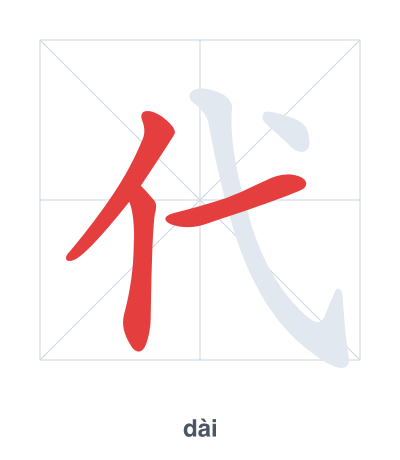
Open Hanzi Writer to see the animated stroke order and practice writing 代 with real-time feedback.
The character 代 (dài) is written with 5 strokes. Follow the standard Chinese stroke order: top to bottom, left to right, outside before inside. The radical 亻 is one of its key components.
Practice the correct stroke order with the Hanzi Writer app to see animated stroke-by-stroke guidance with real-time feedback.
代 means to replace; generation; era.
As an HSK Level 3 character, 代 is an intermediate-level character.
代 combines the person radical 亻 with 弋, which originally depicted a stake or arrow. The character suggests a person taking up a tool or position, hence the meanings 'to replace' or 'a generation' (a succession of people).
💡 Memory Tip: Picture a person (亻) holding a spear-shaped tool (弋) to swap places with another guard, marking the start of a new era.
他代表公司发言。
tā dài biǎo gōng sī fā yán
He speaks on behalf of the company.
这是一个现代城市。
zhè shì yí gè xiàn dài chéng shì
This is a modern city.
谁能代替他去?
shuí néng dài tì tā qù
Who can go in his place?
Open Hanzi Writer to see the animated stroke order and practice writing 代 with real-time feedback.
✨ Animated stroke order · Handwriting recognition · HSK-graded practice · Free to use
The character 代 is made of two parts: the left side is 亻, the person radical, and the right side is 弋, which means 'to shoot' or 'an arrow'. Together, they suggest a person taking action, which connects to the meanings of 'to replace' or 'a generation' (a change of people over time).