Hanzi Writer

How to Write 曾 (céng/zēng) — Meaning “Once / formerly / great- (as in great-grandchild)”

céng/zēng HSK Level 3 12 strokes Radical: 曰

曾 (céng/zēng) means "Once / formerly / great- (as in great-grandchild)" in Chinese. It has 12 strokes with the radical 曰, and is HSK Level 3.

Rated 3.9/5 in difficulty (challenging).

Harder than 58% of HSK Level 3 characters.

Appears in 4+ common words including 曾经 (céng jīng), 未曾 (wèi céng), 曾祖父 (zēng zǔ fù).

Due to its 12 strokes, Hanzi Writer's error detection shows 曾 requires focused practice — most learners need 10+ attempts for consistent accuracy.
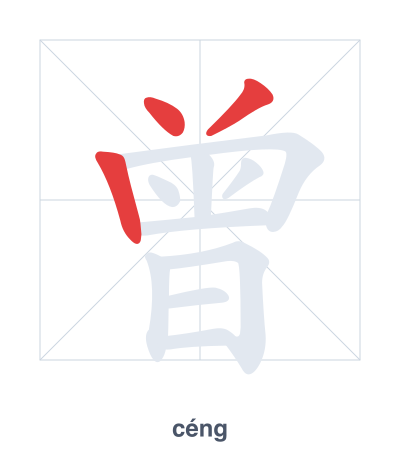
Stroke order practice for 曾 - céng/zēng

Practice Writing 曾 (céng/zēng)

Open Hanzi Writer to see the animated stroke order and practice writing 曾 with real-time feedback.

The character (céng/zēng) is written with 12 strokes. Follow the standard Chinese stroke order: top to bottom, left to right, outside before inside. The radical is one of its key components.

Practice the correct stroke order with the Hanzi Writer app to see animated stroke-by-stroke guidance with real-time feedback.

means Once / formerly / great- (as in great-grandchild).

This is a polyphonic character with readings: céng, zēng.

As an HSK Level 3 character, is an intermediate-level character.

Character
Pinyincéng / zēng (ceng/zeng)
MeaningOnce / formerly / great- (as in great-grandchild)
Strokes12
Radical
HSK Level3
Difficulty3.9/5

Originally a pictograph of a steam-cooking vessel (甑), showing steam (丷) rising from a pot (曰) over a fire (bottom 日). It was later borrowed for its sound to mean 'once' and 'great-grandparent' in kinship terms.

💡 Memory Tip: Picture a great-grandparent (曾) who once (céng) cooked food with steam (丷) rising from a pot (曰) under the sun (日) of long ago.

céng jīng
Once / formerly
wèi céng
Never / Have not yet
zēng zǔ fù
Great-grandfather.
zēng sūn
Great-grandson

我曾经去过北京,那里的故宫很宏伟。

wǒ céng jīng qù guò běi jīng nà lǐ de gù gōng hěn hóng wěi

I have been to Beijing; the Forbidden City there is magnificent.

这一别,他们竟然再也未曾谋面。

zhè yī bié tā men jìng rán zài yě wèi céng móu miàn

After this parting, they unexpectedly never met again.

我的曾祖父是一位非常长寿的老人。

wǒ de zēng zǔ fù shì yī wèi fēi cháng cháng shòu de lǎo rén

My great-grandfather was a very long-lived elderly man.

爷爷最高兴的事就是逗他的小曾孙玩。

yé yé zuì gāo xìng de shì jiù shì dòu tā de xiǎo zēng sūn wán

Grandpa's greatest joy is playing with his little great-grandson.

Character Pinyin Strokes Radical
(current) céng / zēng 12
cáo 11
màn 11
12
Stroke order practice for 曾 - céng/zēng

Practice Writing 曾 (céng/zēng)

Open Hanzi Writer to see the animated stroke order and practice writing 曾 with real-time feedback.

✨ Animated stroke order · Handwriting recognition · HSK-graded practice · Free to use

Frequently Asked Questions about 曾

The character 曾 combines the radical 曰 (sun or speak) on top and a variation of 日 (sun) or 田 (field) below, but its modern structure is not a simple picture of 'once.' Historically, it may relate to layers or addition, which connects to meanings like 'once' (past time) and 'great-' (as in great-grandparent, adding a generation). The radical 曰 is a clue that the character is related to speech or time, though the exact etymology is uncertain.

More HSK Level 3 Characters

Characters with Radical 曰

Other 12-Stroke Characters