痰 (tán) means "phlegm; sputum" in Chinese. It has 13 strokes with the radical 疒, and is HSK Level 7.
Rated 4.2/5 in difficulty (advanced).
Harder than 73% of HSK Level 7 characters.
Appears in 3+ common words including 吐痰 (tǔ tán), 咳痰 (ké tán), 化痰 (huà tán).
Due to its 13 strokes, Hanzi Writer's error detection shows 痰 requires focused practice — most learners need 10+ attempts for consistent accuracy.
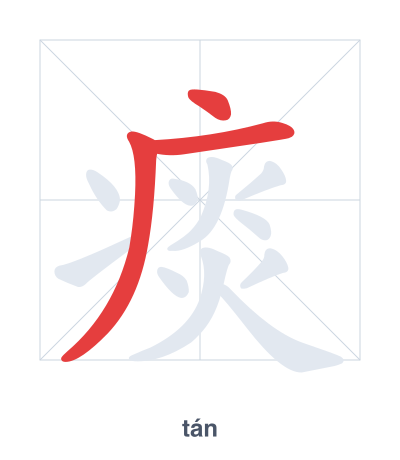
Open Hanzi Writer to see the animated stroke order and practice writing 痰 with real-time feedback.
The character 痰 (tán) is written with 13 strokes. Follow the standard Chinese stroke order: top to bottom, left to right, outside before inside. The radical 疒 is one of its key components.
Practice the correct stroke order with the Hanzi Writer app to see animated stroke-by-stroke guidance with real-time feedback.
痰 means phlegm; sputum.
As an HSK Level 7 character, 痰 is an intermediate-level character.
痰 combines the sickness radical 疒 with 炎 (flame), suggesting that phlegm is traditionally associated with internal heat or inflammation, while 炎 also provides the sound component (tán from yán with tone change).
💡 Memory Tip: Picture a sick person (疒) with two flames (炎) in their chest, burning and turning into sticky phlegm they cough up.
请不要随地吐痰。
qǐng bú yào suí dì tǔ tán
Please don't spit on the ground.
他感冒了,经常咳痰。
tā gǎn mào le jīng cháng ké tán
He has a cold and often coughs up phlegm.
这种药有化痰的作用。
zhè zhǒng yào yǒu huà tán de zuò yòng
This medicine helps to dissolve phlegm.
Open Hanzi Writer to see the animated stroke order and practice writing 痰 with real-time feedback.
✨ Animated stroke order · Handwriting recognition · HSK-graded practice · Free to use
The character 痰 is composed of the radical 疒 (illness) on the left and the phonetic component 炎 (yán, flame) on the right. The radical 疒 indicates that the character relates to disease or sickness, while 炎 provides a hint for pronunciation. Together, they form a character meaning "phlegm," a bodily fluid associated with illness.