痍 (yí) means "wound; bruise" in Chinese. It has 11 strokes with the radical 疒.
Rated 4.2/5 in difficulty (advanced).
Appears in 3+ common words including 疮痍 (chuāng yí), 痍伤 (yí shāng), 创痍 (chuàng yí).
Due to its 11 strokes, Hanzi Writer's error detection shows 痍 requires focused practice — most learners need 10+ attempts for consistent accuracy.
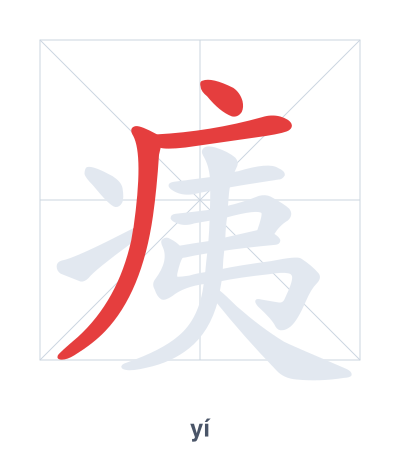
Open Hanzi Writer to see the animated stroke order and practice writing 痍 with real-time feedback.
The character 痍 (yí) is written with 11 strokes. Follow the standard Chinese stroke order: top to bottom, left to right, outside before inside. The radical 疒 is one of its key components.
Practice the correct stroke order with the Hanzi Writer app to see animated stroke-by-stroke guidance with real-time feedback.
痍 means wound; bruise.
痍 is a compound character. The radical 疒 (sickness) indicates an injury or illness, while 夷 (yí) provides the phonetic component and also suggests destruction, as wounds 'level' the skin surface. Together they form the meaning of 'wound' or 'bruise'.
💡 Memory Tip: Imagine a barbarian (夷) strikes you with a club, leaving a nasty wound that sends you to the sickbed (疒).
战争留下了满目疮痍。
zhàn zhēng liú xià le mǎn mù chuāng yí
The war left behind widespread devastation.
他的心里满是痍伤。
tā de xīn lǐ mǎn shì yí shāng
His heart is full of scars.
灾区到处都是创痍。
zāi qū dào chù dōu shì chuàng yí
The disaster area is covered in devastation and scars.
Open Hanzi Writer to see the animated stroke order and practice writing 痍 with real-time feedback.
✨ Animated stroke order · Handwriting recognition · HSK-graded practice · Free to use
The character 痍 has two parts: the radical 疒 on the left, which means "illness" or "sickness," and the phonetic component 夷 on the right, which gives the pronunciation yí. Together, 疒 (illness) and 夷 combine to suggest a wound or bruise, since injuries are a form of illness or damage to the body.