塔 (tǎ) means "tower / pagoda" in Chinese. It has 12 strokes with the radical 土, and is HSK Level 6.
Rated 4.2/5 in difficulty (advanced).
Harder than 55% of HSK Level 6 characters.
Appears in 3+ common words including 水塔 (shuǐ tǎ), 灯塔 (dēng tǎ), 金字塔 (jīn zì tǎ).
Due to its 12 strokes, Hanzi Writer's error detection shows 塔 requires focused practice — most learners need 10+ attempts for consistent accuracy.
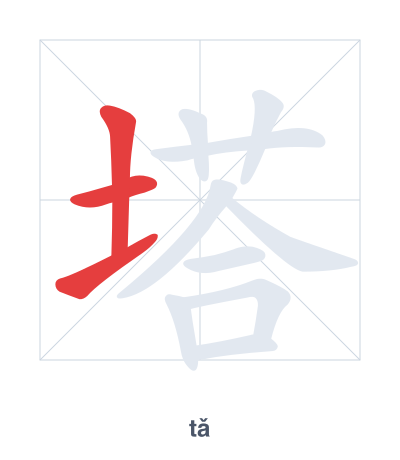
Open Hanzi Writer to see the animated stroke order and practice writing 塔 with real-time feedback.
The character 塔 (tǎ) is written with 12 strokes. Follow the standard Chinese stroke order: top to bottom, left to right, outside before inside. The radical 土 is one of its key components.
Practice the correct stroke order with the Hanzi Writer app to see animated stroke-by-stroke guidance with real-time feedback.
塔 means tower / pagoda.
As an HSK Level 6 character, 塔 is an intermediate-level character.
This character is a phono-semantic compound of 土 (earth, indicating the building material) and 荅 (dā, providing pronunciation). It originally referred to a Buddhist pagoda, a multi-storied tower often built from earth or brick.
💡 Memory Tip: Picture a pagoda made of earth (土) with grass (艹) growing from its top, uniting (合) all levels as it reaches toward the sky.
村子里有一个高水塔。
cūn zi lǐ yǒu yí gè gāo shuǐ tǎ
There is a tall water tower in the village.
灯塔在海边发光。
dēng tǎ zài hǎi biān fā guāng
The lighthouse shines by the sea.
我想去埃及看金字塔。
wǒ xiǎng qù āi jí kàn jīn zì tǎ
I want to go to Egypt to see the pyramids.
Open Hanzi Writer to see the animated stroke order and practice writing 塔 with real-time feedback.
✨ Animated stroke order · Handwriting recognition · HSK-graded practice · Free to use
塔 combines the radical 土 (earth) on the left with the phonetic component 荅 on the right. The 土 radical hints that a tower or pagoda is traditionally built from earth or stone. The right part 荅 gives the pronunciation tǎ, even though it originally means 'to answer.'