埂 (gěng) means "ridge (in a field)" in Chinese. It has 10 strokes with the radical 土.
Rated 4.2/5 in difficulty (advanced).
Appears in 3+ common words including 田埂 (tián gěng), 埂子 (gěng zi), 土埂 (tǔ gěng).
Due to its 10 strokes, Hanzi Writer's error detection shows 埂 requires focused practice — most learners need 10+ attempts for consistent accuracy.
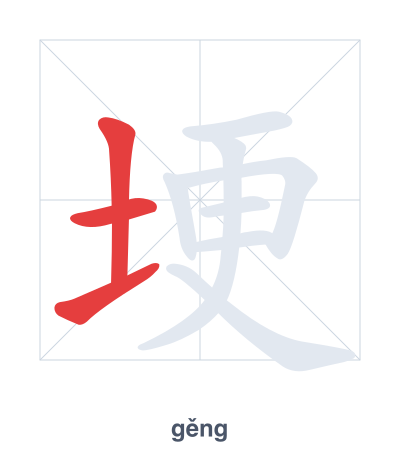
Open Hanzi Writer to see the animated stroke order and practice writing 埂 with real-time feedback.
The character 埂 (gěng) is written with 10 strokes. Follow the standard Chinese stroke order: top to bottom, left to right, outside before inside. The radical 土 is one of its key components.
Practice the correct stroke order with the Hanzi Writer app to see animated stroke-by-stroke guidance with real-time feedback.
埂 means ridge (in a field).
埂 is a compound character with the radical 土 (earth) indicating it relates to soil or land. The right component 更 (gèng) originally meant 'to change' and serves as a phonetic hint for pronunciation. Together, they depict a raised strip of earth that changes the division of fields—a ridge.
💡 Memory Tip: Imagine the earth (土) being changed (更) into a long, raised ridge that snakes across the field like a solid snake.
农民走在田埂上。
nóng mín zǒu zài tián gěng shàng
The farmer is walking on the ridge between fields.
孩子在埂子上跑。
hái zi zài gěng zi shàng pǎo
The child is running on the ridge.
这里有一道土埂。
zhè lǐ yǒu yī dào tǔ gěng
There is an earthen ridge here.
Open Hanzi Writer to see the animated stroke order and practice writing 埂 with real-time feedback.
✨ Animated stroke order · Handwriting recognition · HSK-graded practice · Free to use
埂 combines the radical 土 (earth, ground) on the left with 更 (gèng, meaning 'change' or 'more') on the right. The 土 indicates the character is related to soil or land, while 更 provides the pronunciation and hints at a raised barrier that 'changes' the shape of a field. Together, they form the meaning of a ridge or low bank of earth in farmland.