垸 (yuàn) means "dyke; embankment" in Chinese. It has 10 strokes with the radical 土.
Rated 4.2/5 in difficulty (advanced).
Appears in 3+ common words including 垸子 (yuàn zǐ), 堤垸 (dī yuàn), 围垸 (wéi yuàn).
Due to its 10 strokes, Hanzi Writer's error detection shows 垸 requires focused practice — most learners need 10+ attempts for consistent accuracy.
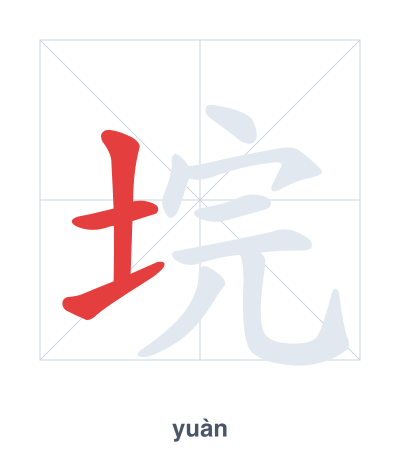
Open Hanzi Writer to see the animated stroke order and practice writing 垸 with real-time feedback.
The character 垸 (yuàn) is written with 10 strokes. Follow the standard Chinese stroke order: top to bottom, left to right, outside before inside. The radical 土 is one of its key components.
Practice the correct stroke order with the Hanzi Writer app to see animated stroke-by-stroke guidance with real-time feedback.
垸 means dyke; embankment.
垸 combines the radical 土 (earth, land) with 完 (to finish, complete), indicating a completed earthwork such as a dyke or embankment. In ancient Chinese, 垸 specifically referred to a reinforced dyke made of packed earth, often used for flood control.
💡 Memory Tip: Picture an embankment of earth (土) that is completely (完) finished, sturdy enough to hold back a flood.
这里的垸子很大。
zhè lǐ de yuàn zǐ hěn dà
The embankment area here is very large.
堤垸保护了农田。
dī yuàn bǎo hù le nóng tián
The embankment protected the farmland.
农民在围垸造田。
nóng mín zài wéi yuàn zào tián
The farmers are building embankments to reclaim land.
Open Hanzi Writer to see the animated stroke order and practice writing 垸 with real-time feedback.
✨ Animated stroke order · Handwriting recognition · HSK-graded practice · Free to use
The character 垸 is made of two parts: the radical 土 (earth) on the left, and 完 (wán, meaning 'complete') on the right. Since a dyke or embankment is built by piling up earth until it is finished, the combination suggests a completed wall of earth used to hold back water.