Hanzi Writer

How to Write 埃 (āi) — Meaning “dust; Angstrom”

āi 10 strokes Radical: 土

埃 (āi) means "dust; Angstrom" in Chinese. It has 10 strokes with the radical 土.

Rated 4.2/5 in difficulty (advanced).

Appears in 3+ common words including 埃及 (āi jí), 尘埃 (chén āi), 埃米 (āi mǐ).

Due to its 10 strokes, Hanzi Writer's error detection shows 埃 requires focused practice — most learners need 10+ attempts for consistent accuracy.
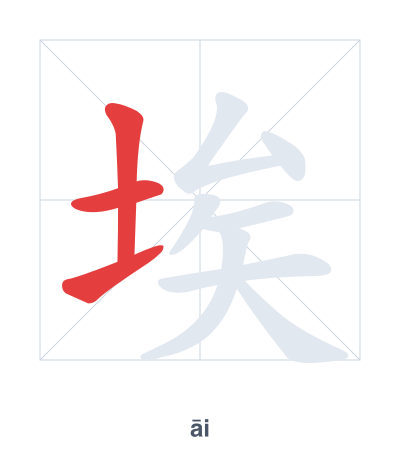
Stroke order practice for 埃 - āi

Practice Writing 埃 (āi)

Open Hanzi Writer to see the animated stroke order and practice writing 埃 with real-time feedback.

The character (āi) is written with 10 strokes. Follow the standard Chinese stroke order: top to bottom, left to right, outside before inside. The radical is one of its key components.

Practice the correct stroke order with the Hanzi Writer app to see animated stroke-by-stroke guidance with real-time feedback.

means dust; Angstrom.

Character
Pinyināi (ai)
Meaningdust; Angstrom
Strokes10
Radical
Difficulty4.2/5

埃 is a phono-semantic compound. The radical 土 (earth/soil) hints at dirt and dust, while 矣 (yǐ) provides the approximate sound āi. The character originally depicted fine soil particles floating in the air, later adopted as the Chinese translation for the Angstrom unit (Å).

💡 Memory Tip: Picture a pile of earth (土) on the left, and on the right imagine a giant mouth (the top of 矣) sneezing out a cloud of fine dust (āi!) that covers everything.

āi jí
Egypt
chén āi
Dust; airborne particles
āi mǐ
Angstrom (unit of length)

埃及是一个古国。

āi jí shì yí gè gǔ guó

Egypt is an ancient country.

阳光下有尘埃。

yáng guāng xià yǒu chén āi

There is dust in the sunlight.

埃米是长度单位。

āi mǐ shì cháng dù dān wèi

Angstrom is a unit of length.

Character Pinyin Strokes Radical
(current) āi 10
8
kūn 8
tǎn 8
Stroke order practice for 埃 - āi

Practice Writing 埃 (āi)

Open Hanzi Writer to see the animated stroke order and practice writing 埃 with real-time feedback.

✨ Animated stroke order · Handwriting recognition · HSK-graded practice · Free to use

Frequently Asked Questions about 埃

埃 combines the radical 土 (earth, soil) on the left with the phonetic component 矣 (yǐ) on the right. The 土 radical suggests dust or dirt, which is related to earth. The right side 矣 provides pronunciation and does not directly contribute to meaning.

Characters with Radical 土

Other 10-Stroke Characters