塑 (sù) means "mold / model / plastic" in Chinese. It has 13 strokes with the radical 土, and is HSK Level 4.
Rated 4.2/5 in difficulty (advanced).
Harder than 66% of HSK Level 4 characters.
Appears in 3+ common words including 塑料 (sù liào), 雕塑 (diāo sù), 塑造 (sù zào).
Due to its 13 strokes, Hanzi Writer's error detection shows 塑 requires focused practice — most learners need 10+ attempts for consistent accuracy.
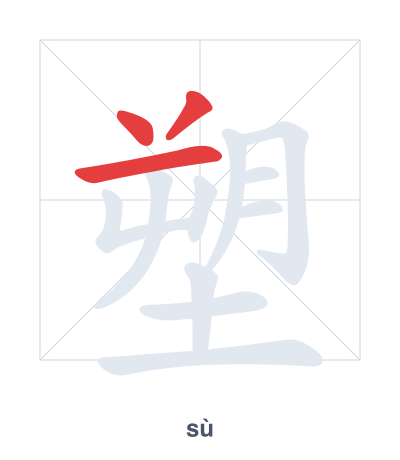
Open Hanzi Writer to see the animated stroke order and practice writing 塑 with real-time feedback.
The character 塑 (sù) is written with 13 strokes. Follow the standard Chinese stroke order: top to bottom, left to right, outside before inside. The radical 土 is one of its key components.
Practice the correct stroke order with the Hanzi Writer app to see animated stroke-by-stroke guidance with real-time feedback.
塑 means mold / model / plastic.
As an HSK Level 4 character, 塑 is an intermediate-level character.
塑 combines the radical 土 (earth/clay) with 朔 (shuò, meaning 'new moon' but used here phonetically), suggesting the action of pressing or shaping clay into a form, like molding a model.
💡 Memory Tip: Picture a sculptor using wet clay (土) to mold a model of a crescent moon (月 inside 朔), but the moon is reversed—imagine squeezing it back into shape with your hands.
请不要用塑料袋。
qǐng bú yào yòng sù liào dài
Please don't use plastic bags.
公园里有一个大雕塑。
gōng yuán lǐ yǒu yí gè dà diāo sù
There is a large sculpture in the park.
他塑造了一个英雄。
tā sù zào le yí gè yīng xióng
He created a hero.
Open Hanzi Writer to see the animated stroke order and practice writing 塑 with real-time feedback.
✨ Animated stroke order · Handwriting recognition · HSK-graded practice · Free to use
塑 consists of the radical 土 (earth/clay) on top and 朔 (shuò, meaning "new moon") below. The 土 radical suggests the material (clay or earth) used for molding, while 朔 provides a phonetic clue to the pronunciation sù. Together, they convey the idea of shaping or molding a material into a form.