酥 (sū) means "flaky or crispy" in Chinese. It has 12 strokes with the radical 酉, and is HSK Level 7.
Rated 4.2/5 in difficulty (advanced).
Harder than 94% of HSK Level 7 characters.
Appears in 3+ common words including 酥油 (sū yóu), 酥脆 (sū cuì), 桃酥 (táo sū).
Due to its 12 strokes, Hanzi Writer's error detection shows 酥 requires focused practice — most learners need 10+ attempts for consistent accuracy.
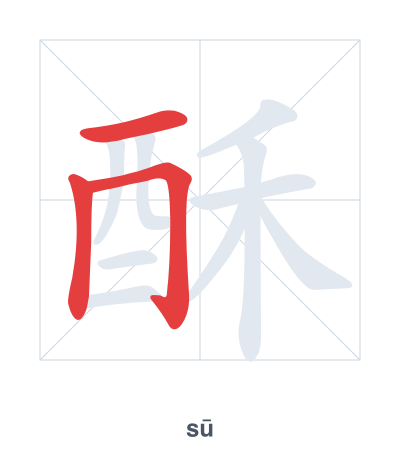
Open Hanzi Writer to see the animated stroke order and practice writing 酥 with real-time feedback.
The character 酥 (sū) is written with 12 strokes. Follow the standard Chinese stroke order: top to bottom, left to right, outside before inside. The radical 酉 is one of its key components.
Practice the correct stroke order with the Hanzi Writer app to see animated stroke-by-stroke guidance with real-time feedback.
酥 means flaky or crispy.
As an HSK Level 7 character, 酥 is an intermediate-level character.
酥 combines 酉 (fermentation vessel) with 禾 (grain) and 夊 (footsteps), suggesting a slow process of fermenting grains to produce a flaky, buttery substance. Originally meaning 'butter' or 'cream', it later extended to describe the crispy, flaky texture of baked goods.
💡 Memory Tip: Picture a wine jar (酉) next to grain (禾) walking away on tiny legs (夊), leaving a trail of crispy flakes.
酥油茶很好喝。
sū yóu chá hěn hǎo hē
Butter tea is very delicious.
这个饼干很酥脆。
zhè ge bǐng gān hěn sū cuì
This biscuit is very crispy.
我喜欢吃桃酥。
wǒ xǐ huān chī táo sū
I like eating walnut cookies.
Open Hanzi Writer to see the animated stroke order and practice writing 酥 with real-time feedback.
✨ Animated stroke order · Handwriting recognition · HSK-graded practice · Free to use
酥 is composed of 酉 (wine jar radical) on the left and 禾 (grain) on the right. The 酉 component hints at fermentation or food preparation, while 禾 represents grain, together suggesting foods made from grain that are crispy or flaky.