舒 (shū) means "Comfortable; to stretch" in Chinese. It has 12 strokes with the radical 舌, and is HSK Level 2.
Rated 3.4/5 in difficulty (challenging).
Harder than 59% of HSK Level 2 characters.
Appears in 3+ common words including 舒服 (shū fú), 舒适 (shū shì), 舒展 (shū zhǎn).
Due to its 12 strokes, Hanzi Writer's error detection shows 舒 requires focused practice — most learners need 10+ attempts for consistent accuracy.
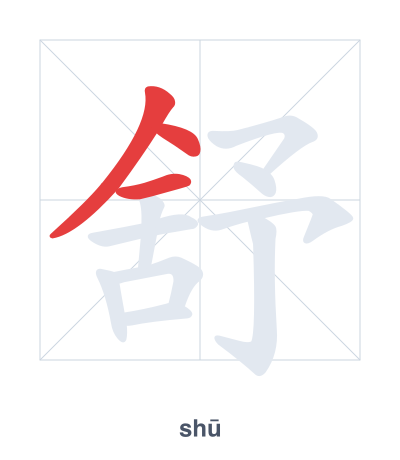
Open Hanzi Writer to see the animated stroke order and practice writing 舒 with real-time feedback.
The character 舒 (shū) is written with 12 strokes. Follow the standard Chinese stroke order: top to bottom, left to right, outside before inside. The radical 舌 is one of its key components.
Practice the correct stroke order with the Hanzi Writer app to see animated stroke-by-stroke guidance with real-time feedback.
舒 means Comfortable; to stretch.
As an HSK Level 2 character, 舒 is among the first characters beginners learn.
舒 combines 舍 (house/shed) and 予 (to give), suggesting giving oneself space to stretch out inside a dwelling. The radical 舌 (tongue) hints at the relaxation that comes with a deep sigh or yawn while stretching.
💡 Memory Tip: Imagine a person in a house (舍) giving (予) themselves a big stretch, feeling totally comfortable.
坐在沙发上很舒服。
zuò zài shā fā shàng hěn shū fú
Sitting on the sofa is very comfortable.
这个房间布置得很舒适。
zhè ge fáng jiān bù zhì dé hěn shū shì
This room is comfortably furnished.
运动后身体感觉很舒展。
yùn dòng hòu shēn tǐ gǎn jué hěn shū zhǎn
The body feels well-stretched after exercise.
Open Hanzi Writer to see the animated stroke order and practice writing 舒 with real-time feedback.
✨ Animated stroke order · Handwriting recognition · HSK-graded practice · Free to use
舒 is made of two parts: the left side 舌 (tongue) and the right side 予 (to give). Together, they suggest the idea of stretching or extending, like sticking out your tongue or giving yourself room, which leads to a feeling of comfort.