舌 (shé) means "tongue" in Chinese. It has 6 strokes with the radical 舌, and is HSK Level 6.
Rated 2.9/5 in difficulty (moderate).
Harder than 8% of HSK Level 6 characters.
Appears in 3+ common words including 舌头 (shé tou), 舌尖 (shé jiān), 口舌 (kǒu shé).
Hanzi Writer's stroke validation shows learners typically need 5-8 attempts to write 舌 with correct proportion and order.
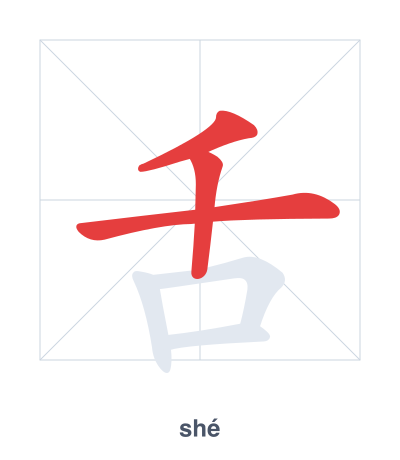
Open Hanzi Writer to see the animated stroke order and practice writing 舌 with real-time feedback.
The character 舌 (shé) is written with 6 strokes. Follow the standard Chinese stroke order: top to bottom, left to right, outside before inside. The radical 舌 is one of its key components.
Practice the correct stroke order with the Hanzi Writer app to see animated stroke-by-stroke guidance with real-time feedback.
舌 means tongue.
As an HSK Level 6 character, 舌 is an intermediate-level character.
This character is a pictograph of a tongue extending from a mouth. The ancient form depicted a tongue (often shown as a forked shape) above a mouth opening. In the modern form, the top part (now resembling 千) represents the tongue, and the bottom 口 is the mouth.
💡 Memory Tip: Picture a thousand tongues (千) sticking out of a mouth (口) to taste everything at once.
医生看了一下我的舌头。
yī shēng kàn le yī xià wǒ de shé tou
The doctor took a look at my tongue.
舌尖上的中国很有名。
shé jiān shàng de zhōng guó hěn yǒu míng
'A Bite of China' is very famous.
别为这件事浪费口舌了。
bié wèi zhè jiàn shì làng fèi kǒu shé le
Don't waste your breath on this.
Open Hanzi Writer to see the animated stroke order and practice writing 舌 with real-time feedback.
✨ Animated stroke order · Handwriting recognition · HSK-graded practice · Free to use
The character 舌 is composed of a top part resembling a "千" (thousand) and a bottom part "口" (mouth). The mouth component directly relates to the tongue's location in the mouth, while the top element suggests the tongue's movement or function. Together, they represent the tongue as an organ inside the mouth.