奢 (shē) means "luxurious; extravagant" in Chinese. It has 11 strokes with the radical 大, and is HSK Level 7.
Rated 4.2/5 in difficulty (advanced).
Harder than 51% of HSK Level 7 characters.
Appears in 3+ common words including 奢侈 (shē chǐ), 奢望 (shē wàng), 奢华 (shē huá).
Due to its 11 strokes, Hanzi Writer's error detection shows 奢 requires focused practice — most learners need 10+ attempts for consistent accuracy.
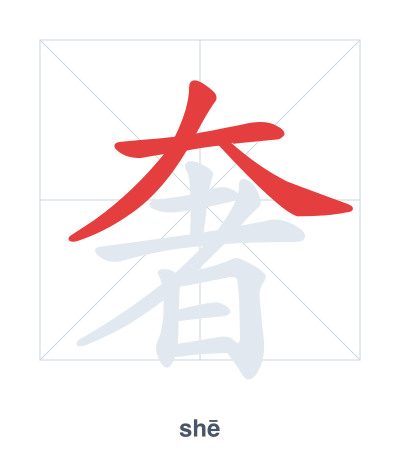
Open Hanzi Writer to see the animated stroke order and practice writing 奢 with real-time feedback.
The character 奢 (shē) is written with 11 strokes. Follow the standard Chinese stroke order: top to bottom, left to right, outside before inside. The radical 大 is one of its key components.
Practice the correct stroke order with the Hanzi Writer app to see animated stroke-by-stroke guidance with real-time feedback.
奢 means luxurious; extravagant.
As an HSK Level 7 character, 奢 is an intermediate-level character.
奢 is a phono-semantic compound combining 大 (big, indicating excess) and 者 (phonetic component, pronounced similarly in ancient times). The big element suggests wasteful abundance or overindulgence, hence 'luxurious' or 'extravagant'.
💡 Memory Tip: Picture a big (大) person (者) draped in gold and jewels, living a life of extreme luxury.
这种生活太奢侈。
zhè zhǒng shēng huó tài shē chǐ
This lifestyle is too extravagant.
我没有太多奢望。
wǒ méi yǒu tài duō shē wàng
I don't have many extravagant hopes.
房间布置很奢华。
fáng jiān bù zhì hěn shē huá
The room is luxuriously furnished.
Open Hanzi Writer to see the animated stroke order and practice writing 奢 with real-time feedback.
✨ Animated stroke order · Handwriting recognition · HSK-graded practice · Free to use
奢 is made of 大 (big) on top and 者 (person) below. The big component suggests excess, and together with the person, it indicates someone who goes beyond normal limits, leading to the meanings of luxurious or extravagant.