奎 (kuí) means "Kui (one of the 28 mansions of Chinese astronomy)" in Chinese. It has 9 strokes with the radical 大.
Rated 4/5 in difficulty (challenging).
Appears in 3+ common words including 奎宁 (kuí níng), 奎星 (kuí xīng), 奎屯 (kuí tún).
Due to its 9 strokes, Hanzi Writer's error detection shows 奎 requires focused practice — most learners need 10+ attempts for consistent accuracy.
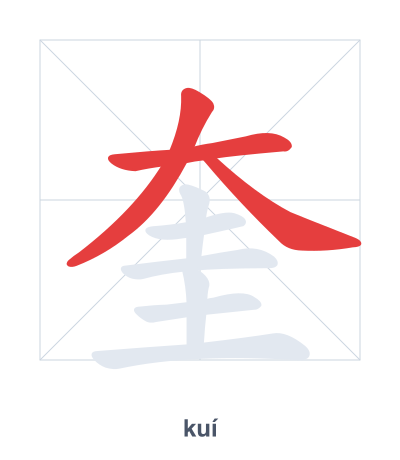
Open Hanzi Writer to see the animated stroke order and practice writing 奎 with real-time feedback.
The character 奎 (kuí) is written with 9 strokes. Follow the standard Chinese stroke order: top to bottom, left to right, outside before inside. The radical 大 is one of its key components.
Practice the correct stroke order with the Hanzi Writer app to see animated stroke-by-stroke guidance with real-time feedback.
奎 means Kui (one of the 28 mansions of Chinese astronomy).
奎 combines 大 (big, representing a person) and 圭 (a jade tablet or stacked earth). In Chinese astronomy, it names one of the 28 mansions, associated with the legs of the Azure Dragon; the character's shape may evoke a person standing with legs apart, forming the 'crotch' area of the constellation.
💡 Memory Tip: Picture a giant (大) standing with two jade tablets (圭) on the ground, marking the stars of the Kui mansion.
医生开了奎宁。
yī shēng kāi le kuí níng
The doctor prescribed quinine.
奎星是古代的星名。
kuí xīng shì gǔ dài de xīng míng
Kuixing is an ancient star name.
他住在奎屯。
tā zhù zài kuí tún
He lives in Kuitun.
Open Hanzi Writer to see the animated stroke order and practice writing 奎 with real-time feedback.
✨ Animated stroke order · Handwriting recognition · HSK-graded practice · Free to use
奎 is composed of 大 (big) on top and 圭 (a jade tablet) below. The top part 大 suggests something large or prominent, while 圭 originally represented a ceremonial jade object. Together, they form the name of a star mansion in Chinese astronomy, symbolizing a significant celestial region.