Hanzi Writer

How to Write 契 (qì) — Meaning “contract; agreement; deed”

HSK Level 7 9 strokes Radical: 大

契 (qì) means "contract; agreement; deed" in Chinese. It has 9 strokes with the radical 大, and is HSK Level 7.

Rated 4/5 in difficulty (challenging).

Harder than 39% of HSK Level 7 characters.

Appears in 3+ common words including 契约 (qì yuē), 默契 (mò qì), 契机 (qì jī).

Due to its 9 strokes, Hanzi Writer's error detection shows 契 requires focused practice — most learners need 10+ attempts for consistent accuracy.
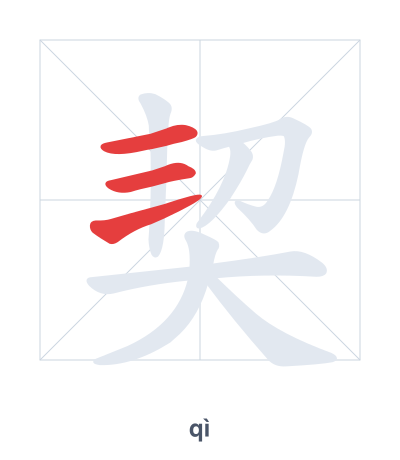
Stroke order practice for 契 - qì

Practice Writing 契 (qì)

Open Hanzi Writer to see the animated stroke order and practice writing 契 with real-time feedback.

The character (qì) is written with 9 strokes. Follow the standard Chinese stroke order: top to bottom, left to right, outside before inside. The radical is one of its key components.

Practice the correct stroke order with the Hanzi Writer app to see animated stroke-by-stroke guidance with real-time feedback.

means contract; agreement; deed.

As an HSK Level 7 character, is an intermediate-level character.

Character
Pinyinqì (qi)
Meaningcontract; agreement; deed
Strokes9
Radical
HSK Level7
Difficulty4/5

契 combines 㓞 (a hand carving notches) and 大 (big), originally depicting the carving of tally marks on a large wooden stick to record agreements—a visual metaphor for contracts and deeds.

💡 Memory Tip: Imagine a giant (大) using a knife (㓞) to carve a contract into a massive stone tablet.

qì yuē
contract; agreement
mò qì
Tacit understanding
qì jī
opportunity; turning point

双方签了契约。

shuāng fāng qiān le qì yuē

Both parties signed a contract.

他们配合得很默契。

tā men pèi hé dé hěn mò qì

They cooperate with great rapport.

这是一个发展的契机。

zhè shì yí gè fā zhǎn de qì jī

This is an opportunity for development.

Character Pinyin Strokes Radical
(current) 9
lián 7
huàn 7
yǎn 8
Stroke order practice for 契 - qì

Practice Writing 契 (qì)

Open Hanzi Writer to see the animated stroke order and practice writing 契 with real-time feedback.

✨ Animated stroke order · Handwriting recognition · HSK-graded practice · Free to use

Frequently Asked Questions about 契

契 is composed of two main parts: the top part is 㓞 (qià, meaning to carve or cut), and the bottom is 大 (dà, meaning big or large). Historically, contracts were made by carving notches on wood or bamboo, so the idea of 'carving' (㓞) on a 'large' piece (大) represents an agreement. This structure visually suggests a formal deed or contract that is significant and permanent.

More HSK Level 7 Characters

Characters with Radical 大

Other 9-Stroke Characters