华 (huá/huà) means "magnificent; Chinese" in Chinese. It has 6 strokes with the radical 十, and is HSK Level 3.
Rated 2.9/5 in difficulty (moderate).
Harder than 21% of HSK Level 3 characters.
Appears in 4+ common words including 中华 (zhōng huá), 华丽 (huá lì), 华山 (huà shān).
Hanzi Writer's stroke validation shows learners typically need 5-8 attempts to write 华 with correct proportion and order.
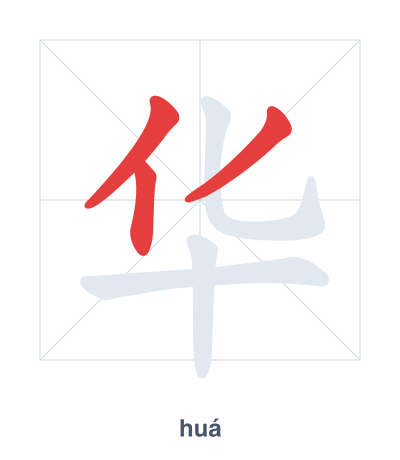
Open Hanzi Writer to see the animated stroke order and practice writing 华 with real-time feedback.
The character 华 (huá/huà) is written with 6 strokes. Follow the standard Chinese stroke order: top to bottom, left to right, outside before inside. The radical 十 is one of its key components.
Practice the correct stroke order with the Hanzi Writer app to see animated stroke-by-stroke guidance with real-time feedback.
华 means magnificent; Chinese.
This is a polyphonic character with readings: huá, huà.
As an HSK Level 3 character, 华 is an intermediate-level character.
Originally a pictograph of a flowering plant (華), it meant 'flower' and later 'splendid' or 'magnificent.' The simplified form 华 combines 化 (change) and 十 (ten), suggesting the transformative richness of Chinese civilization.
💡 Memory Tip: Picture a person (亻) changing (化) into ten (十) magnificent forms, each representing a different aspect of Chinese culture.
中华文化博大精深,有着悠久的历史。
zhōng huá wén huà bó dà jīng shēn yǒu zhe yōu jiǔ de lì shǐ
Chinese culture is broad and profound, with a long history.
礼堂里挂着几盏华丽的水晶吊灯。
lǐ táng lǐ guà zhe jǐ zhǎn huá lì de shuǐ jīng diào dēng
There are several magnificent crystal chandeliers hanging in the auditorium.
华山以其险峻而闻名于世,吸引了无数游客。
huà shān yǐ qí xiǎn jùn ér wén míng yú shì xī yǐn liǎo wú shù yóu kè
Mount Hua is world-famous for its steepness and attracts countless tourists.
华姓是一个历史悠久的古老姓氏。
huá xìng shì yí gè lì shǐ yōu jiǔ de gǔ lǎo xìng shì
The surname Hua is an ancient surname with a long history.
Open Hanzi Writer to see the animated stroke order and practice writing 华 with real-time feedback.
✨ Animated stroke order · Handwriting recognition · HSK-graded practice · Free to use
华 is composed of the radical 十 (ten) on top and a simplified form of 化 (change) below. The top part 十 can be seen as a cross or symbol of completeness, while the bottom 化 suggests transformation, together conveying the idea of something splendid or refined, much like Chinese civilization itself.