侈 (chǐ) means "extravagant; wasteful; excessive" in Chinese. It has 8 strokes with the radical 亻, and is HSK Level 7.
Rated 3.4/5 in difficulty (challenging).
Harder than 12% of HSK Level 7 characters.
Appears in 3+ common words including 奢侈 (shē chǐ), 奢侈品 (shē chǐ pǐn), 侈谈 (chǐ tán).
Due to its 8 strokes, Hanzi Writer's error detection shows 侈 requires focused practice — most learners need 10+ attempts for consistent accuracy.
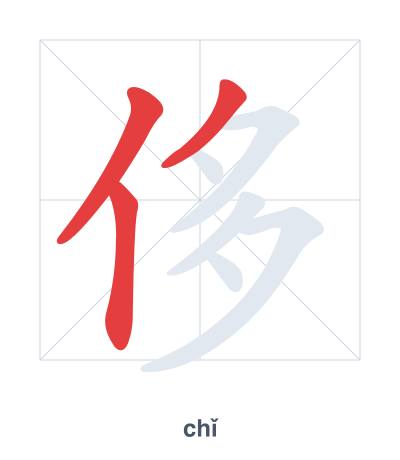
Open Hanzi Writer to see the animated stroke order and practice writing 侈 with real-time feedback.
The character 侈 (chǐ) is written with 8 strokes. Follow the standard Chinese stroke order: top to bottom, left to right, outside before inside. The radical 亻 is one of its key components.
Practice the correct stroke order with the Hanzi Writer app to see animated stroke-by-stroke guidance with real-time feedback.
侈 means extravagant; wasteful; excessive.
As an HSK Level 7 character, 侈 is an intermediate-level character.
This character combines 'person' (亻) with 'many' (多). It originally depicted a person surrounded by many goods, implying wastefulness. The idea is someone with excessive amounts, hence extravagant.
💡 Memory Tip: Picture a person (亻) flinging away two fistfuls of coins (多) in a wild, wasteful spree.
浪费食物是很奢侈的。
làng fèi shí wù shì hěn shē chǐ de
Wasting food is very extravagant.
她喜欢买昂贵的奢侈品。
tā xǐ huān mǎi áng guì de shē chǐ pǐn
She likes to buy expensive luxury goods.
现在侈谈成功还太早。
xiàn zài chǐ tán chéng gōng hái tài zǎo
It is too early to talk grandly about success now.
Open Hanzi Writer to see the animated stroke order and practice writing 侈 with real-time feedback.
✨ Animated stroke order · Handwriting recognition · HSK-graded practice · Free to use
侈 is made of the radical 亻(person) on the left and 多(duō, many) on the right. The person radical indicates something related to people, while 多 suggests excess. Together, they convey the idea of a person having too much, which leads to extravagance or wastefulness.