商 (shāng) means "business / commerce / to discuss" in Chinese. It has 11 strokes with the radical 口, and is HSK Level 1.
Rated 3.4/5 in difficulty (challenging).
Harder than 73% of HSK Level 1 characters.
Appears in 3+ common words including 商店 (shāng diàn), 商业 (shāng yè), 商量 (shāng liáng).
Due to its 11 strokes, Hanzi Writer's error detection shows 商 requires focused practice — most learners need 10+ attempts for consistent accuracy.
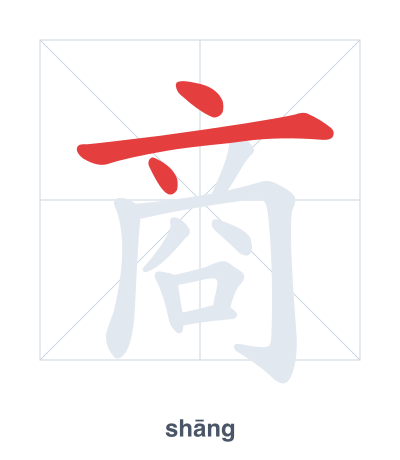
Open Hanzi Writer to see the animated stroke order and practice writing 商 with real-time feedback.
The character 商 (shāng) is written with 11 strokes. Follow the standard Chinese stroke order: top to bottom, left to right, outside before inside. The radical 口 is one of its key components.
Practice the correct stroke order with the Hanzi Writer app to see animated stroke-by-stroke guidance with real-time feedback.
商 means business / commerce / to discuss.
As an HSK Level 1 character, 商 is among the first characters beginners learn.
商 was originally a pictograph of a ritual vessel with a lid, used for offerings. It later came to represent the Shang dynasty, whose people were active traders, giving the character its meanings of commerce and discussion. The radical 口 (mouth) emphasizes the verbal negotiation aspect of trade.
💡 Memory Tip: Picture a merchant at a stall (the top part 亠+冏 like a canopy) haggling with a customer (口 as mouths talking) over prices.
我去商店买东西。
wǒ qù shāng diàn mǎi dōng xī
I'm going to the store to buy some things.
这个城市的商业很发达。
zhè ge chéng shì de shāng yè hěn fā dá
Commerce in this city is very developed.
我们商量一下这件事。
wǒ men shāng liáng yī xià zhè jiàn shì
Let's discuss this matter.
Open Hanzi Writer to see the animated stroke order and practice writing 商 with real-time feedback.
✨ Animated stroke order · Handwriting recognition · HSK-graded practice · Free to use
商 is made of three parts: a top lid (亠), a middle mouth (口), and a bottom window-like shape (冏). The mouth and window suggest discussing or negotiating in a marketplace, linking to its meanings of business, commerce, and discussion.