害 (hài) means "Harm / To hurt" in Chinese. It has 10 strokes with the radical 宀, and is HSK Level 3.
Rated 4.2/5 in difficulty (advanced).
Harder than 73% of HSK Level 3 characters.
Appears in 3+ common words including 害怕 (hài pà), 害羞 (hài xiū), 厉害 (lì hài).
Due to its 10 strokes, Hanzi Writer's error detection shows 害 requires focused practice — most learners need 10+ attempts for consistent accuracy.
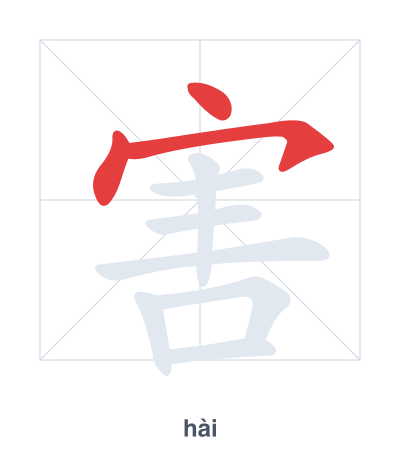
Open Hanzi Writer to see the animated stroke order and practice writing 害 with real-time feedback.
The character 害 (hài) is written with 10 strokes. Follow the standard Chinese stroke order: top to bottom, left to right, outside before inside. The radical 宀 is one of its key components.
Practice the correct stroke order with the Hanzi Writer app to see animated stroke-by-stroke guidance with real-time feedback.
害 means Harm / To hurt.
As an HSK Level 3 character, 害 is an intermediate-level character.
The character 害 originally depicted a house (宀) with a mouth (口) and a pestle or thorny plant (丰) inside, symbolizing a harmful action or injury occurring within a home. Over time, it came to represent any kind of harm or damage.
💡 Memory Tip: Picture a roof (宀) covering a mouth (口) that is being stabbed by a thorny branch (the middle part like 丰) — that's definitely harmful!
我害怕一个人。
wǒ hài pà yí gè rén
I'm afraid of being alone.
她害羞地笑了。
tā hài xiū dì xiào le
She smiled shyly.
你真厉害!
nǐ zhēn lì hài
You are really amazing!
Open Hanzi Writer to see the animated stroke order and practice writing 害 with real-time feedback.
✨ Animated stroke order · Handwriting recognition · HSK-graded practice · Free to use
害 consists of three parts: the roof radical 宀 on top, a mouth 口 in the middle, and the component 丰 (meaning 'abundant') at the bottom. This combination suggests 'too much talk under a roof' which can lead to harm or trouble. The radical 宀 gives a sense of home or shelter, while the mouth and abundance imply harmful words or actions.